Category Archives: pickering laboratories

Quiz #47 – Piston Washed Out

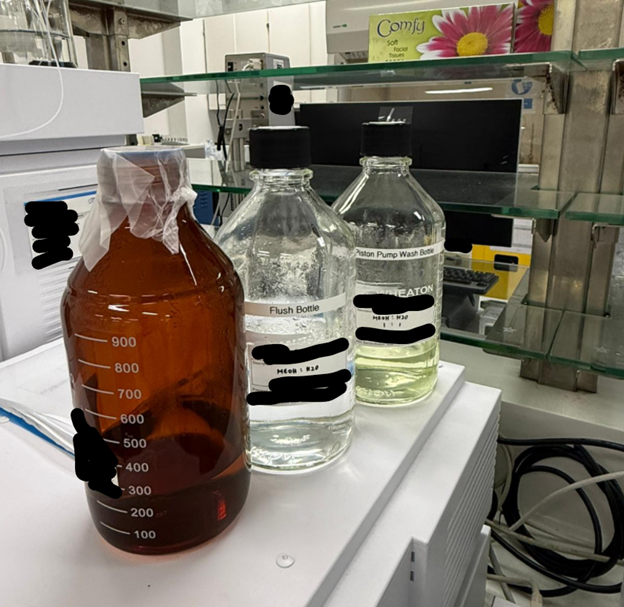
Here we have a customer with a Pinnacle PCX and they are observing some discoloration in the piston wash solution. Under normal circumstances, the solution has no color and now the solution is yellowish and the piston wash volume continues to increase.

What could be causing this problem with the customers piston wash solution?

Submit your answers to rsmith@pickeringlabs.com by December 31, 2025!

Announcing the winners of our previous quiz, Chromatography Quiz #46 – Peaking at the wrong time

Pickering Laboratories would like to congratulate the winners for our previous newsletter’s Chromatography Quiz #46: Tom Schneider from SCWA, Josiah Hakala from Minnesota Department of Health, and Narjes Ghafoori from Los Angeles County Public Health Laboratory. 

Our winners will shortly be receiving: a $100 gift card from Amazon.com! 

Congratulations to our quiz winners!  Thank you all for your submissions!


Chromatography Quiz #46 Solution:

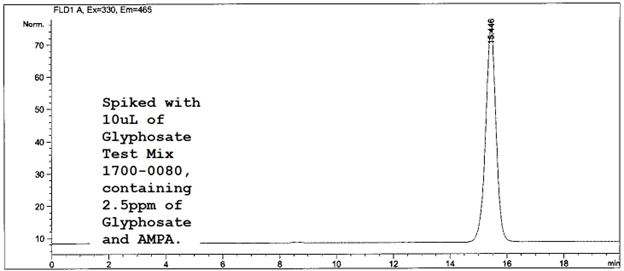
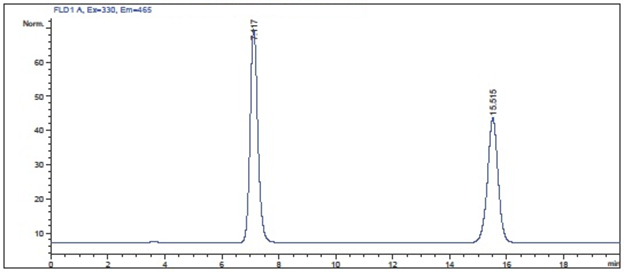
For reference, here is what we observed and also what a good chromatogram looks like:

Troubleshooting Chromatogram:

Reference Chromatogram:

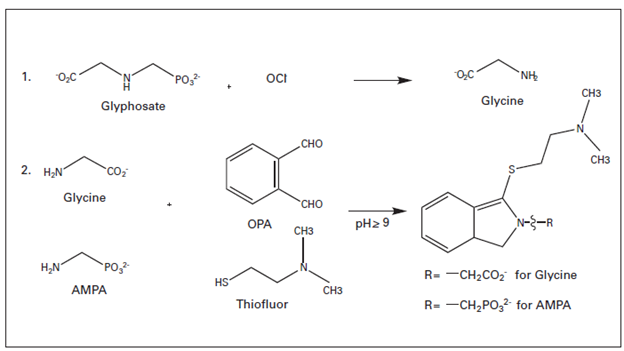
For this problem, we take a look at the chemical reaction taking place:

In the first stage, glyphosate is oxidized by hypochlorite to glycine. In the second stage, glycine reacts with o-phthalaldehyde and Thiofluor™ (a mercaptan) at pH 9–10 to produce a highly fluorescent isoindole. AMPA does not need the initial oxidation to react with OPA.

We observed only AMPA and are suspicious of the reagent 1 preparation or possible a physical problem with Pump 1. If there is a problem with the oxidizing reagent, there will be no Glyphosate signal. AMPA does not require oxidation to react with OPA.


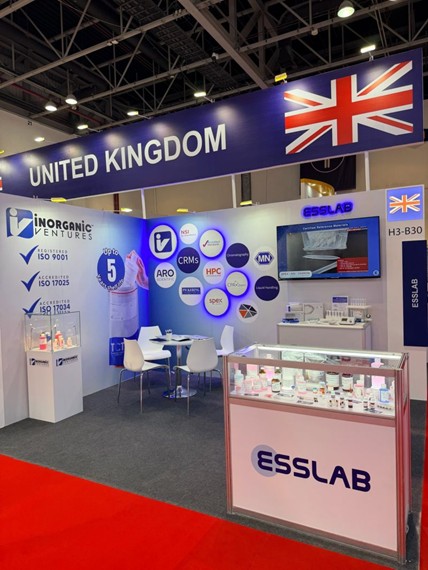
Esslab Attends ArabLab

By: Kevin McKeown

In a previous installment of our newsletter, we introduced our new Product Testing Solutions (PTS) aka Artificial Body Fluids dealer for the UK/EU: EssLab

Well, now EssLab has brought the Pickering Test Solutions product line to a new part of the world by featuring us on their booth at ArabLab!

There was a lot of interest in artificial body fluids and this served as the introduction of our products to a new audience of analysts.  ArabLab serves as a meeting point for laboratory equipment manufacturers, life-sciences firms, diagnostics, environmental monitoring, petrochemical testing, food/beverage analysis, and other segments.  This region of the world is making a significant investment in scientific infrastructure, regulatory standards and innovation in analytical/laboratory technology.  We are thrilled that we have a partner who can take our products to countries, and customers, that previously had no easy way of knowing who we are.

This should be a sneak preview of more joint work between Pickering Labs and EssLab.  You can look out for this dynamic duo to be teaming up at conferences throughout the UK/EU in the years to come… maybe even in Munich, Germany in a few short months!

Studying Paralytic Shellfish Toxins in the Pacific Walrus

By: Dr. Maria Ofitserova

Rebecca Smith, President, pictured with her Walrus friend named “Garfield”!

We didn’t want you to think that we only write about our Artificial Body Fluids, so we wanted to pass along an interesting study done utilizing the post-column derivatization method for Paralytic Shellfish Toxins (PSTs).

Alexandrium catenella is a species of dinoflagellates that produce Paralytic Shellfish Toxins that accumulate in bivalves and some fish. As ocean waters warm in the Alaskan Arctics, Harmful Algae Bloom (HAB) caused by rapid increase in population of Alexandrium catenella happens more and more frequently.  Increase in neurotoxins contamination levels of shellfish poses considerable health risk to humans and animals, even causing mass mortality events in large marine mammals.

A study recently published in Harmful Algae journal was using data on paralytic shellfish toxins found in Alexandrium catenella and in shellfish to validate models of PSTs transfer in a critical Arctic food chain and calculate walruses’ toxins exposure during Alexandrium HAB events.

The study was using post-column derivatization method to determine concentrations of toxins in different matrices. Pickering Laboratories’ Onyx PCX derivatization system is ideal for this application and we also offer reagents and HPLC eluants to help laboratories who would like to save time on preparations of the solutions and take advantage of consistent batch to batch performance of consumables manufactures by our company. Application notes MA105 and MA105.1 (https://www.pickeringlabs.com/wp-content/uploads/2021/05/Paralytic-Shellfish-Toxins-MA105.pdf) describe post-column analysis of Paralytic Shellfish Toxins according to official AOAC 2011.02.

The study publication is available here:

https://www.sciencedirect.com/science/article/pii/S1568988325001623

Celebrating 25 Years with Pickering Labs: Anita Gribaldo

By: Christopher Nguyen

This month, we’re proud to celebrate Anita Gribaldo’s 25th work anniversary at Pickering Laboratories!

As our Packaging Lead, Anita has spent a quarter century ensuring every product that leaves our doors meets the highest standards. Her exceptional attention to detail and commitment to quality have made her an indispensable part of our team.

Anita’s reliability, precision, and pride in her work — and in her Polish heritage — reflect the very best of Pickering Labs. We’re grateful for her dedication and the consistency she’s brought to every project over the years.

Congratulations, Anita, on this incredible milestone — and thank you for 25 years of excellence!

New Bioz Partnership for Pickering Labs!

By: Kevin McKeown

You may have seen that our websites: www.pickeringlabs.com and www.pickeringtestsolutions.com have gotten a VERY cool addition: Bioz badges


One of the most common questions that we receive from our customer is, “Can I use your artificial body fluids for ______ (insert your sample type or method of analysis!)?”  Previously, we would draw off anecdotal evidence that we may have collected over the years or, in most cases, hesitate to make any suggestions, as our customers know their samples WAY better than we ever could.  Now, we have an easy, searchable way for anyone to explore what our artificial body fluids have been used for. 

From Bioz’s website, here’s the explanation of their service:

Bioz operates a specialized AI-powered search engine designed for life science researchers in academia and the biopharma industry. They mine, analyze and structure huge volumes of scientific literature to provide

What this means for you, and us, is that there is now a way to explore the many ways that our products have been deployed.  Some of our favorites that we have found so far: Small-scale storable paper biobatteries activated via human bodily fluid, Cerumen/Earwax as a means of diagnostic testing, Lung Fluid for the testing of inhaled microplastics and the list goes on!

We encourage you to go hunting yourself and find out about all the different studies that we have been a part of!

Quiz #45 – Amino Acids Rising Baseline

Quiz #45 – Amino Acids Rising Baseline

In this fast amino acids chromatogram (method abstract here), you will see a rising baseline at the time of injection. What is contributing to this baseline artifact? You will find an example of the rising baseline below along with Onyx PCX pump pressure trace.  

Closeup of the rising baseline at time of injection

Submit your answers to rsmith@pickeringlabs.com by November 15, 2024.


Announcing the winners of our previous quiz, Chromatography Quiz #44 – Amino Acids Noisy Baseline

Pickering Laboratories would like to congratulate the winners for our previous newsletter’s Chromatography Quiz: Jeff Fan from Thermo Fisher Scientific, Thomas Schneider from SCWA, Narjes Ghafoori from Los Angeles County Public Health Laboratory, and Josiah Hakala from Minnesota Department of Health.

They have won, and will shortly be receiving: Best Bloody Mary Mix Gift Box

Congratulations to our quiz winners!  Thank you all for your submissions!


Chromatography Quiz #44 Solution:

In this amino acids chromatogram per European Pharmacopeia (method abstract here), you will see a noisy baseline with repetitive sinusoidal noise pattern (green and blue). What is contributing to this baseline noise?


Question: What is causing the baseline noise?

Correct answer:

In this case, the noise in the baseline was caused by the HPLC pump. The seal/needle wash bottle had dried up, causing abnormal pressure fluctuations and leading to sinusoidal spikes in the baseline.

Pinnacle Obsolescence Update

Pinnacle Obsolescence Update

Dear Valued Customer,

Please note that the Pinnacle has not been in production since the year 2020. We will continue to maintain replacement parts and support the Pinnacle PCX until January 1, 2030.

The Onyx PCX is our sleek next generation upgrade to the Pinnacle and it delivers the same seamless operation and optimized analysis each and every time you run a sample. Replacing the Pinnacle, the Onyx PCX is the latest addition to our integrated family of post-column derivatization instruments, chemistry and support instrumentation.

The Onyx PCX is amazingly simple and intuitive, producing results you can rely on. Its reliable performance, elegant design, ease of use, and minimal maintenance make it the optimal Post-column system for research and analytical testing laboratories, as well as pharmaceutical and biotech companies. The Onyx PCX is capable of connecting to an array of HPLC units to meet your testing needs. Pickering Laboratories still offers the only instrumentation optimized for the analysis of Amino Acids, Carbamates, Glyphosate, Mycotoxins, Antibiotics and many other applications.

Pickering Laboratories commitment to quality and providing customers with technical solutions means that we maintain a robust application-specific quality system, testing every instrument and consumable exactly as our customer will be using our products.  It also means we pride ourselves in being a leader in innovation by developing, producing, and delivering safe, effective, high quality post-column instruments and consumables that meet or exceed our customer expectations, on time, every time. We achieve these objectives through our chemists’ precision and expertise as well as adopting industry best practices and operating in the spirit of continuous improvement.

To learn more about the new Onyx PCX please consider reading our exciting new brochure!

Please contact Pickering Laboratories Support at (650)694-6700, (800)654-3330, or support@pickeringlabs.com if you have any questions.

Regards,

David Mazawa

Technical Support Chemist
Pickering Laboratories, Inc.