
Pickering Laboratories
Menu
 
Menu

Quiz #48 – Valve Lost Error

Pickering Laboratories – Chromatography Quiz

Announcing the winners of our previous quiz, Chromatography Quiz #47 – Piston Washed Out

Pickering Laboratories would like to congratulate the winners of our previous newsletter’s Chromatography Quiz #47: Marissol Mallon from Suffolk County Water Authority, Lakeisha Packer from Pennsylvania Department of Agriculture, Tom Schneider from Suffolk County Water Authority, Josiah Hakala from Minnesota Department of Health, and Narjes Ghafoori from Los Angeles County Public Health Laboratory.

Our winners will shortly be receiving a Reclaimed Wood Herb Garden, just in time for Spring! An herb garden with three fragrant pre-planted herbs: rosemary, thyme, and sage. Planted in a rustic reclaimed wood crate, to nestle perfectly on a sunny windowsill or kitchen counter. Happy growing!

Congratulations to our quiz winners!  Thank you all for your submissions!

Chromatography Quiz #47 Solution:Discoloration in the piston wash is usually an indication that reagent has leaked into the piston wash bottle. The backend of the piston of the pump is directly connected to the piston wash. If the main piston seal is bad, you can have a small amount of reagent leak into the piston wash bottle.
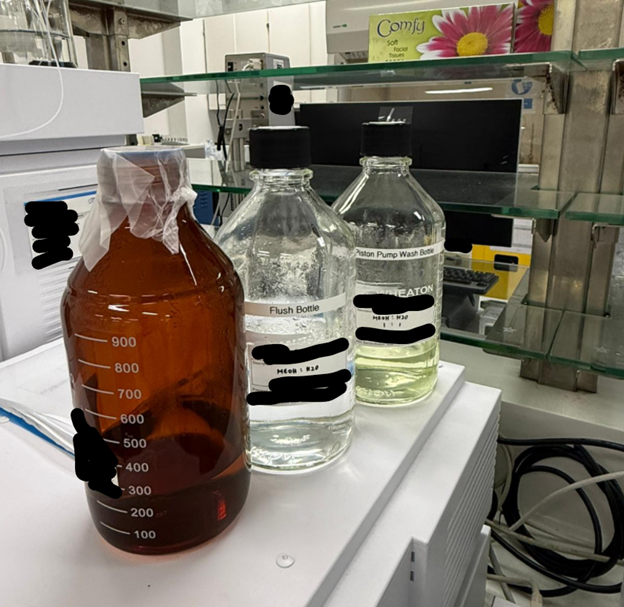
It is recommended to change the pump seals and then perform a pressure test to make sure the seal integrity is good.

Quiz #48 – Valve Lost Error

Here is a question for our Pinnacle and Onyx PCX users. A possible error for your system is a “Vale Lost” error. The valve assembly uses optical sensors to determine which position the valve is in. If the valve is unable to arrive at a programmed position, you will receive a Valve Lost Error.

What can lead to a Valve Lost Error? 

Submit your answers to rsmith@pickeringlabs.com by April 17, 2026!

Winter Newsletter 2026 — Nature Article

By: Kevin McKeown


In what has to be our biggest citation yet, Pickering Labs Artificial Sweat has been referenced in an article in Nature magazine!
https://www.nature.com/articles/s44460-025-00005-z

From the abstract:

Cortisol is a key regulator of stress and circadian physiology, yet current monitoring relies on invasive blood sampling or saliva assays that are prone to contamination and provide limited temporal resolution. Wearable sweat cortisol sensors are promising, but require electronic sensing systems and have limited capability for long-term, time-sequenced monitoring. Here we present a wearable paper-based microfluidic platform that integrates plasmonic-gold-nanoflower-based colorimetric assays to enable non-invasive tracking of cortisol in eccrine sweat. Sweat is induced by carbachol iontophoresis and directed through collection channels using either electronically timed sequential activation or paper-based delay valves with self-powered electrochromic indicators. In human studies, the system resolved circadian variations, acute stress responses to cold pressor challenges, and jet-lag-associated disruptions, with the results closely matching those from saliva and serum assays. This wearable lateral flow technology establishes sweat as a viable medium for real-time hormone monitoring and may enable personalized management of stress, sleep and circadian misalignment.

The analysts used our Artificial Eccrine Perspiration formulation, which is our closest “mimic” to actual human sweat and a perfect medium for replicating real-life conditions. We know that cortisol, the “stress hormone,” can lead to some undesirable medical problems, and it’s neat to know that we had a small part in potentially detecting irregularities.

We are seeing some really great applications for our products in the Wearable Tech market, with an emphasis on Medical Monitoring. It’s always very interesting to get a feel for what our products are used for, and anything that can help to prevent jet lag is something I am here for!

Paralytic Shellfish Methods

By: Kevin McKeown

Looking for a one-stop shop for any and all Shellfish Toxin information?! Look no further:
https://www.pickeringlabs.com/products/paralytic-shellfish-methods

This new landing page links to our Method Abstracts, including our new method that includes GTX6, as some regulatory agencies require its identification and quantification. These toxins are neurotoxic compounds produced by marine dinoflagellates that accumulate in bivalve mollusks such as mussels, clams, oysters, and scallops. Harmful algae blooms occur unpredictably, and contaminated shellfish can cause paralytic shellfish poisoning, so routine monitoring is necessary to protect public health. Historically, detection relied on the mouse bioassay, but this approach has several limitations, prompting the development of chemical analysis techniques using chromatography.

Also included on this page is some further information on our new reagents, specifically manufactured to be run with our instrument. If you are looking for a ready-made analytical solution, we also have an application kit, which will feature all 6 reagents and mobile phases.

This is a fast-developing area of interest in the public health space, and please continue to monitor this landing page for any method updates and additional information. If you have any questions on instrument configuration, appropriate methodology, or anything else, please just get in touch and we’d be happy to discuss!

Fluorescamine – High-Purity Derivatization Reagent for Sensitive Post-Column Analysis

Fluorescamine – High-Purity Derivatization Reagent for Sensitive Post-Column Analysis

Fluorescamine is a widely used derivatization reagent that reacts rapidly with primary amino groups to form highly fluorescent derivatives. It has been extensively utilized for post-column analysis of a broad range of analytes, including amino acids, peptides, proteins, and other amino-containing compounds such as cephalosporin antibiotics.

This reagent is particularly valuable for high-sensitivity analysis of large molecules such as proteins and peptides. The fluorescent derivatives formed do not undergo self-quenching, preserving the intensity of the fluorescent signal. This property enables reliable trace-level analysis of hormones and pharmaceuticals in blood and other biological matrices, as well as use in purity confirmation assays.

In post-column trace analysis, reagent quality is critical to minimizing background signal and preventing analytical interferences. Pickering Laboratories specializes in high-purity derivatization reagents and is proud to announce the addition of highly purified crystalline fluorescamine to our product catalog.

Celebrating 25 Years of Excellence: Maria Ofitserova

By Christopher Nguyen 

This year, we are proud to celebrate a remarkable milestone for one of our own. Dr. Maria Ofitserova, Senior Research Chemist at Pickering Laboratories, marked her 25-year anniversary in February!

Over the past quarter century, Maria has played an essential role in advancing the science behind our products. Her deep expertise, natural curiosity, and unwavering commitment to quality have helped ensure that Pickering Laboratories continues to deliver the reliable, high-performance solutions our customers depend on. Maria’s contributions extend beyond the lab—her collaborative spirit and dedication have made her a valued colleague and mentor to many across our organization.


Milestones like this reflect not only individual achievement, but also the strength and continuity of our scientific community. Maria’s work has helped shape our standards, strengthen our innovation, and support our mission of excellence.

We are sincerely grateful for Maria’s 25 years of dedication, innovation, and teamwork, and we look forward to her continued contributions in the years ahead.

Please join us in congratulating Maria on this extraordinary milestone!

Analytica Announcement

Analytica Announcement

By: Kevin McKeown

Time to dust off those passports and pack your bags, as Pickering Labs will be exhibiting at Analytica 2026 in Munich!

Analytica 2026 is Europe’s premier international trade fair for laboratory technology, analytical science, and biotechnology, taking place from March 24–27, 2026 at the Trade Fair Center Messe München in Munich, Germany. It brings together thousands of scientists, industry leaders, researchers, and decision-makers from around the world to showcase cutting-edge innovations in areas such as analysis, diagnostics, lab automation, sustainability, and digital transformation, with more than 1,000 exhibitors spread across five halls.

In something new for us, we will be sharing the booth with our UK/EU distributor: EssLab. Our booth will be in the UK Pavilion, in Hall B1. In attendance from Pickering Labs will be Rebecca Smith and Kevin McKeown, with a strong contingent from our EssLab partners, including Richard Day, Chris Hoskyn, Karolina Perek, and others. Our main focus at this show will be our PTS (Artificial Body Fluids) line, and we’ll have real-life samples of your favorite Blood, Sweat, and Saliva solutions! If you, or anyone from your company, plan on attending, we encourage you to stop by and say hello. In a bit of foreshadowing, I can promise that you will not miss us in our neon color-schemed attire! As an added bonus, we’ll have some “fresh off the press” giveaways.

We look forward to seeing all of our customers, international dealers, and old friends. We wish everyone who’s attending safe travels and cannot wait to see you there!

Introduction – Winter 2026 Newsletter

By: Kevin McKeown

After an exceptionally snowy last few months on the East Coast and a wet and rainy season on the West Coast, I bet you cannot wait: it’s time for the (late) Winter 2026 edition of the Pickering Laboratories newsletter, Retention Times!

In this issue, we’ll share fun staff news and celebrations while also mixing in our usual blend of product updates from both the Post-Column and PTS/Artificial Body Fluids product lines.

First, we kick things off with an announcement about our next exhibition at Analytica. We will be teaming up with our UK/EU PTS dealer, EssLab, and will be in Hall B1, Booth 333A. Come by and say hi to Rebecca, Kevin, and the EssLab team!

Next, we celebrate our dear colleague Maria’s 25th anniversary! Dr. Maria Ofitserova is a treasured member of our team, and many of you have had the opportunity to benefit from her vast wealth of knowledge on both Post-Column and Artificial Body Fluids topics and applications.

Speaking of Maria, she is introducing a new product: Fluorescamine. This new product is used in conjunction with a growing application area for Post-Column analysis—peptides. With GLP-1s all over the news, we wanted to join the action and provide our customers with another option for sourcing their method-specific consumables.

If you thought we’d make it through a newsletter without mentioning shellfish, I’m sorry to disappoint! In our PSP Landing Page, we showcase the newest resource added to our website. There you’ll be able to find method abstracts, brochures, and other helpful materials if you are—or are considering—getting your lab ready for PTOX testing. Spring is right around the corner, and the water will soon be heating up!

Finally, we highlight a paper in which our products were used for sweat cortisol monitoring. We’ve had a great time combing through our citations, but a recent one really stood out. The fact that it was published in Nature initially caught our attention, as it is such a prominent publication—but the study itself is fascinating, tackling a problem many of us experience: jet lag.

But wait, there’s more! We couldn’t publish a newsletter without our very popular Chromatography Quiz, so put on your thinking caps and see if you can figure out why David’s customer is experiencing a Valve Lost Error. Send in your answers for a chance to win a fabulous prize!

Guaranteed Chemistry