
Pickering Laboratories – Chromatography Quiz
Announcing the winners of our previous quiz, Chromatography Quiz #48 – Valve Lost Error
Pickering Laboratories would like to congratulate the winners of our previous newsletter’s Chromatography Quiz #48: Kushaal Chokhany from Eurofins BioPharma Product Testing, Narjes Ghafoori from County Public Health Laboratory, Josiah Hakala from Minnesota Department of Health, Marissol Mallon from Suffolk County Water Authority, and Tom Schneider from Suffolk County Water Authority.
Our winners will shortly be receiving a delicious Snack Lovers Box! A gourmet assortment of sweet and savory goodies. The perfect time for Fall snacking and Football viewing!

Congratulations to our quiz winners! Thank you all for your submissions!
Chromatography Quiz #48 Solution:
The seals in the valve are too tight. When the valve seals are too tight, they place too much load on the valve motor. The motor may then be unable to move the valve insert properly, causing the insert to miss its targeted position and the valve to become “lost.”
To correct the problem, clean the valve and replace the seals with new seals. Incorporating a flush method at the end of your sequence can also help extend the life of your pump and valve seals.
A common troubleshooting technique can help determine whether the Valve Lost Error is being caused by the valve face or by the valve motor assembly. Power down the Onyx, remove the valve face so there is no load on the valve motor, then power the Onyx back on and allow it to perform the valve initialization process.
If the valve completes initialization with no load on the motor, this indicates that the valve face is causing the Valve Lost Error. If the valve cannot complete initialization even with no load on the motor, this can indicate a problem with the valve motor assembly or a board failure.
For further troubleshooting assistance, contact support@pickeringlabs.com.
Quiz #49 – Better Late Than Never?
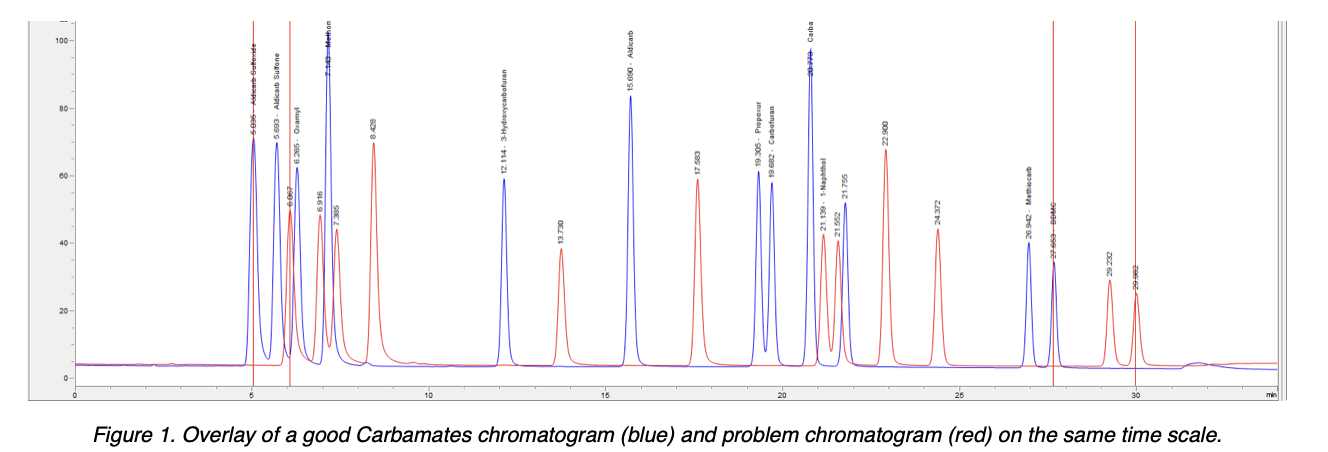
Something isn’t quite right with this Carbamates analysis. The chromatogram below shows an overlay of two runs using the same time scale.
The blue trace represents a good Carbamates chromatogram, while the red trace represents the problem chromatogram. Compared with the blue chromatogram, the peaks in the red chromatogram are eluting later than expected, with a smaller response for several of the peaks.
Chromatographic Conditions
|
Column |
Pickering High Resolution/Capacity Carbamate Column, P/N 0846250, C8, 4.6 x 250 mm, 5 um |
|
Flow Rate |
1.0 mL/min |
|
Column Temperature |
42 deg C |
|
Post-Column Reagent Flow Rate |
0.3 mL/min |
|
Reactor 1 |
100 deg C, 0.5 mL |
|
Reactor 2 |
Ambient, 0.1 mL |
|
Detection |
Fluorescence, excitation 330 nm / emission 465 nm |
Imagine the red chromatogram appeared during your analysis. Where would you start troubleshooting?
What problem could explain both the late-eluting peaks and the smaller response?
Submit your answers to rsmith@pickeringlabs.com by [DATE]!