There is a saying, “one cannot make an omelet without breaking a few eggs”. What do omelets and eggs have to do with post-column instrumentation? No direct correlation, but both have an underlying parameter that is important in achieving the final goal. Too much pressure on the egg and you will end up with egg shells in your omelet, too little pressure and there might not be an omelet.
In the case of the post-column derivatizer, there is a sweet spot (pressure range) that relates to a system that is working well. The system pressure is mostly comprised of the reagent pump(s) pressure(s) and gives an idea of how the overall system is performing. Too high and there is a constriction problem, too low and there is a leak in the flow path.
The pump pressure measures the pressure downstream from the pressure transducer. This includes the heated reactor, filters, unions, detector, and flow path tubing. All of these components have to be looked into when troubleshooting a high pressure problem. The best troubleshooting method is to remove one component at a time to look for the pressure drop; it is best to work backwards (start from the outlet of the detector). Components to pay attention to are: back pressure regulator, detector, ambient reactor, heated reactor, restrictors if there are any and last but not least the reagent filters. A significant drop (greater than 100 psi) in pressure when one of the components is removed would indicate that it is the source of the problem. The same thought process works for leaks also! Take a lint free towel and wipe all connections one by one, looking for areas of wetness that would indicate a leak.
Since summer is around the corner and graduations, admissions applications and final exams (to name a few) have been taken care of, please do take time to hit the sweet spot by enjoying the great outdoors!
The 68th Pittcon International for 2018 was hosted in Orlando, Florida which provided a welcome respite from February’s wintery embrace to many a northerner. Beside the welcoming venue, the programs and exhibitors continue to contribute to the leading exhibition for laboratory science and new technology in food safety, life science and emerging markets.
Pickering Laboratories presented the latest method advances in our Post-Column Applications and received significant interest in our recently introduced Product Test Solutions from a diverse audience of conference attendees.
New from Pickering for Pittcon this year was our post-column application for Cannabinoids Analysis in Cannabis Plants and Edibles, Amino Acid Analysis in Foods and Supplements as well as several new formulations of Product Testing Solutions.
We are always surprised at the variety of companies interested in our product testing solutions: credit card manufacturers, tobacco companies, electronics manufacturers, surgical instrumentation companies, materials scientists, pharmaceutical companies, and makers of musical instruments to name a few. These different industries have all found the quality and consistency of Pickering’s product testing solutions to offer the reliability they need for performing product development and ongoing quality assurance testing.
To add to the excitement of our new products, we held daily raffles for an Apple Watch and two Bose Soundsport Pulse headphones. Congratulations to our three winners!
Not only were the winners of the raffle prizes excited, but passersby generated quite a buzz checking out this year’s playful Pickering promotional handouts, including: Fidget Spinners, Emoji Pens, Lab Rulers and Workout Towels. We enjoyed engaging with our visitors and we appreciated those who stopped to learn more about what Pickering Labs offers!
Thank you for visiting our booth at Pittcon! And if you missed us, our next show is the North American Chemical Residue Workshop (NACRW) in Naples, Florida from July 22 through 25, where you can be sure to see myself and Sareeta Nerkar and pick up some application notes (or another emoji pen)!
Chromatography Quiz #28: 35th Anniversary Word Puzzle – Results
Pickering Labs would like to congratulate all of our winners for our previous newsletter’s 35th Anniversary Word Puzzle: Jim Balk from Nebraska DHHS Public Health Environmental Laboratory, Tom Schneider from Suffolk County Water Authority, Karissa Scroggins from North Coast Laboratories, Narjes Ghafoori from LA County Environmental Toxicology Lab, Joy Gottlieb from New Mexico Department of Health Scientific Lab Division, Hossein Hajipour from Texas Dept. of State Health Services Laboratories, and Widchuda Meeim from Thailand Bureau of Quality Control of Livestock Products.
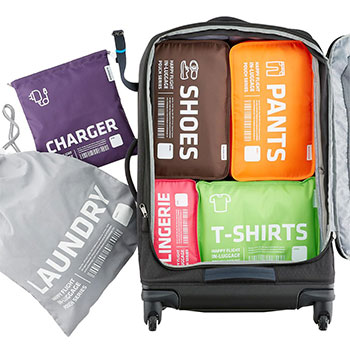
Winners will soon receive a Packing Organizer Set from the Container Store! This colorful set of 6 packing cubes are durable and clearly labeled to help you organize your suitcase! Just in time as you plan for those summer getaways!
Congratulations to our quiz winners and happy packing!
Thank you all for your submissions!
The correct answers for the Anniversary Word Puzzle are as follows:
Simply email your answer as well as your full contact information to Rebecca at rlsmith@pickeringlabs.com by July 15, 2018 in order to win. You will receive email confirmation that your submission has been received. The answer to the quiz and winner congratulations will be published in the next issue (to be anonymous, please notify Rebecca in submission).
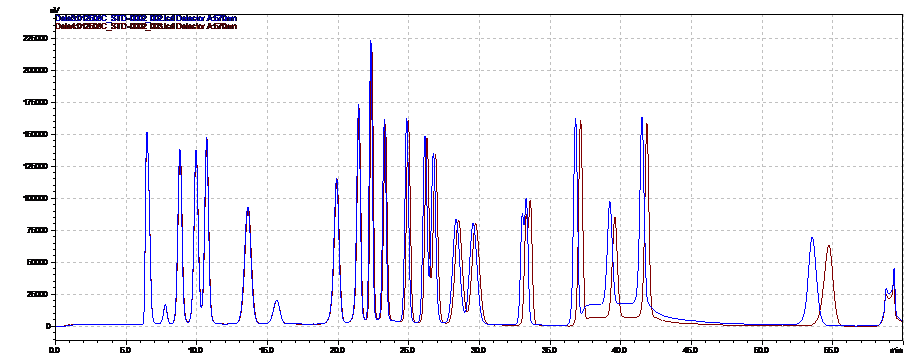
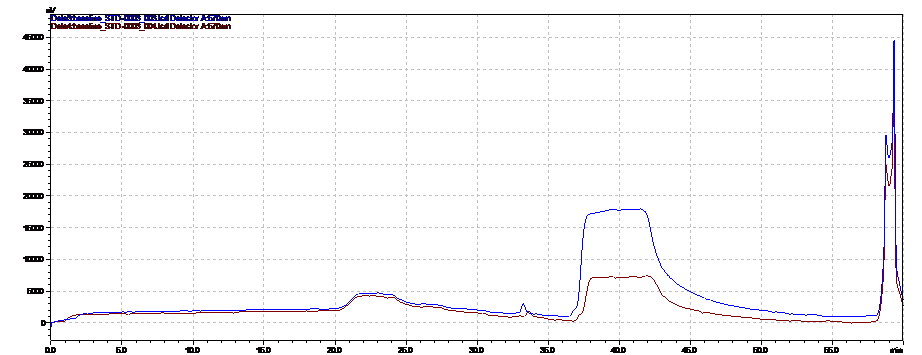
Maroon: Good chromatogram
Blue: Elevated baseline
What could be contributing to the elevated baseline?
Four years into our 40-year marriage, I can recall Michael saying “I know I can improve amino acid analysis” with such enthusiasm it could only mean big things. He’d finished up his second post-doc and was working in industry – a startling contrast, to be sure, but moving every year was increasingly difficult with our growing family. So, we settled in the Bay Area permanently and he started first with Durham Instruments and then worked for Spectra Physics. At the time, amino acid analysis was taking chemists on the order of 12 hours per run! Reducing the run time to three hours was only the first of many developments Michael had up his sleeve.
Within the year, Michael left his job to start Pickering Laboratories with our flagship product: Trione®, our ninhydrin reagent. The first bottles were sent out to industry experts for evaluation, and became our ambassadors carrying with them our hope of building a successful business. I remember it was important to Michael for the bottles of Trione® to ship upright, because he thought of them as little soldiers marching off to the marketplace to do the job of defending his reputation and building our brand.
The early days of the business were challenging. Michael did all the phases of production, taking orders as well as all of the manufacturing, packaging and shipping. He even “hired” our two older kids to wash the bottles sometimes. I was working in corporate marketing at the time, so I would attend trade shows and help Michael network with potential customers. We didn’t want people to know we were such a small company, so I used my maiden name to give the appearance I was an employee instead of his wife!
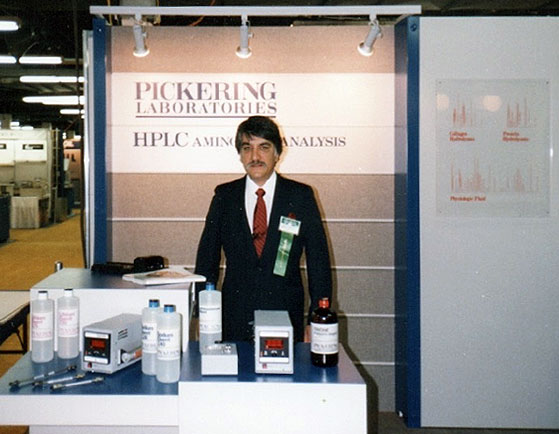
Michael at One of Our Early Booths.
When Michael would talk to chemists about Trione®, they would get so excited about this breakthrough reagent for amino acids analysis. We were always grateful so many people offered their advice and counsel just to help the enterprise along. It was rough-and-tumble for the first year or two, and every encouraging word helped keep us going.
Customer orders began building momentum, and Michael and I breathed a sigh of relief! Michael hired an additional 3-4 people on staff and I quit my job to help with administrative duties and expanding our marketing efforts. He determined there was demand for a post-column derivatization instrument, and the PCX5000 was born. Our earliest foray into instrumentation came as a benchtop kit, with standalone components including a pump, mixing system and reactor. Michael initially didn’t want Pickering Labs to be an instrument company, but we found that the instruments were needed to support the sale of our Trione® reagent and also the growing family of buffers we were selling.
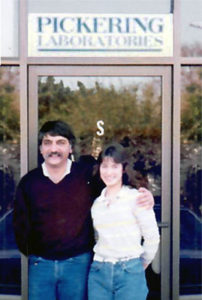
Michael and Our Oldest Daughter in Front of Our First Building.
Michael’s reputation for post-column expertise began gaining attention from other chemists whose applications were post-column but not amino acid analysis. As a result, Michael began to explore these other industries’ post-column needs. And when he developed Pickering’s OPA-reagent-based products for analysis of Carbamates and Glyphosate, he entered into the world of environmental testing and began working with EPA methods. Chemists who had previously been making their own eluents by following the EPA methods could now buy Michael’s ready-to-use buffers and purified reagents instead. And they kept reordering because of the quality and reproducibility that Michael’s chemistry delivered. He would even say that he would “guarantee the chromatogram” to any chemist using his products, which was unprecedented.
With the administrative/office duties securely staffed and the business looking more and more like a successful enterprise, I stepped back into a part-time role and focused on marketing. As our family expanded, my time also became more occupied at home (our two youngest daughters were born in the mid-80’s). By the end of the eighties, Michael was ready to hire additional staff to manage the business so he could really focus on his true passion: research and product development.
In fact, as I think about that time, the early nineties are when the company really started to take shape in its modern form. Michael added then-Operations-Manager Jim Murphy to manage the business in 1991 (Jim is our current President) and shifted fully into a technical role. They also hired a full-time marketing manager, and so I went to work soon thereafter for the Palo Alto school district.
Michael and his team evolved the PCX5000 standalone kit into the PCX3100 and PCX5100, our first fully-integrated post-column derivatization instruments. Michael also developed more post-column applications with the collaboration of EPA, FDA, AOAC and CDFA, all of which further expanded our chemistries and columns offered. Which in turn cemented our customer base and reputation for making the post-column instruments. The business experienced steady growth, and the PCX3100 and PCX5100 sold well and supported our chemistry sales exactly as we’d envisioned.
Pickering Labs celebrating its 35th anniversary is a wonderful chance for me to reflect on working so closely with Michael during the first ten years of the business. And I’d like to use our newsletter as an opportunity to introduce myself, or reintroduce myself to our long-time customers. After my retirement from the school district, I began getting involved in the business again and joined the Board of Directors in 2014. My work with the Pickering team behind the scenes isn’t very visibile to our customers, but I hope this gives us an opportunity to remember Michael together and that you enjoy my fond recollections (and new perspective?) of how Pickering Labs began.
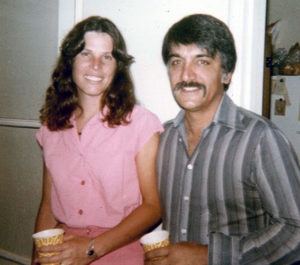
Michael and Judy Pickering, Back When It All Started.
Pickering Labs Celebrates Our 35th Anniversary with 1980’s Pictures!!!
Anita and Severo are Respectively Our Packaging and Shipping/Receiving Experts!
Jim is Pictured here (Long Before His Cleanshaven Days As Our Current President)!
Gabriela and Jay are Both Production Chemists and Manufacture the Bulk of Our Reagents and Eluents!
David and Maria are Both Chemists, He’s Tech Support and She Heads Up R&D!
Saji, our QC Manager, is Pictured here on Her Wedding Day in 1982. She and George have been Married 35 Years!!
Sareeta is a Research Chemist and Rebecca Manages Operations.
Mike, Seen here with Bride Martha, is Our Marketing Manager.
Judy Pickering, Owner, Pictured here with Our Founder Michael.
Gloria is an Administrator and Our Longest Tenured Employee at 26 Years! Anthony is Our Newest Team Member – Working in Manufacturing for About a Year.
Tony (Middle) is Our Production Manager and Still Rocks That Same ‘stache…Looks Like It’s Genetic!
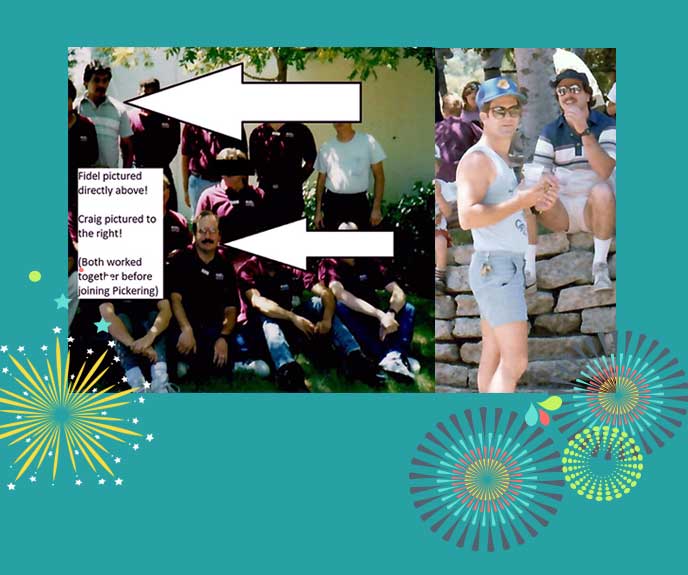
Fidel and Craig Both Work in Our Manufacturing Department, Building Vectors and Packing Analytical Columns! On the Right is Another Picture of Craig (Hey Jim, Down in Front!).
They Couldn’t Get Us Actual Pictures From the 80s, but They Did Pose for Some Awesome 80s Themed Photos! Ed Works in Manufacturing Building Pinnacles and Diana Handles Order Entry and Accounts Payable.
Thank you to our entire team for participating in this awesome project! We hope you enjoyed our anniversary flashback party!!
Thank you for being our customer and we hope you enjoy these fantastic photos. Our employees had a lot of fun digging through their old scrapbooks to help create this blast from the past!
In the field of analytical chemistry, one of the important industry standards organizations is The Association of Analytical Communities – AOAC international. Founded in 1884, the organization has since developed and validated analytical methods for agriculture, pharmaceuticals, foods and other products for the United States and internationally.
Pickering Laboratories began its collaboration with AOAC almost 30 years ago with the introduction of EPA official methods for Carbamates and Glyphosate analysis in water based on post-column derivatization. Our company organized workshops and training sessions to help implement these methods in government and private labs. Pickering Laboratories also started manufacturing reagents and other consumables for Carbamates and Glyphosate analysis methods so testing laboratories could have confidence in the quality and reproducibility of the solutions and save valuable time by avoiding making small batches themselves.
“Michael Pickering always supported the AOAC and the state labs in providing workshops and extensive support.” Laszlo Torma, Former Director of the Montana Department of Agriculture Analytical Laboratory. Laszlo continues “Michael made many enduring friendships because of his very personable and expert guidance.”
Pickering Laboratories was invited to present workshops at many of the AOAC regional section meetings. At the Midwest AOAC, Pickering Laboratories organized workshops for Amino Acids Analysis and Multi-Residue Mycotoxins Analysis in foods. At the Pacific Northwest AOAC meeting, Pickering Laboratories presented a workshop on the Paralytic Shellfish Toxins Analysis with HPLC and post-column derivatization. This was one of the critical steps in the transition to requiring this new post-column method and replacing the mouse bio-assay for analysis of Paralytic Shellfish Toxins.
Pickering Laboratories has also participated in several multi-lab collaborative studies organized by AOAC and our chemists have published many method validations in the Journal of AOAC International. Our post-column method for Multi-Residue Mycotoxins Analysis was awarded the ‘Single Laboratory Validation of the Year’ distinction by AOAC in 2009.
AOAC continues its great work as a leading standards-developing organization by assembling Stakeholders Panels that consist of representatives from industry, testing laboratories, researchers and government organizations to determine the needs for new methods. Vetted chemists are invited to join Expert Review Panels, who evaluate these incoming new methods to determine they are scientifically sound, reproducible and rugged. Expert Review Panels make the final determine if the method can be granted an official AOAC method status.
Today, Pickering Laboratories continues our legacy of AOAC collaboration with Dr. Maria Ofitserova, our Senior Research Chemist, who is empaneled on several committees.
AOAC Stakeholder Panel on Dietary Supplements (SPDS)
AOAC Stakeholder Panel on Infant Formula and Adult Nutritionals (SPIFAN)
Expert review panel for SPIFAN
The futures for AOAC and Pickering Laboratories are both dependent on the collaboration of standards bodies and the industries that rely on them for the creation and validation of methods that enable the analyses required to keep our foods and drugs safe.
Pickering Laboratories would like to congratulate the winners of our last newsletter’s Glyphosate Quiz – Only AMPA:Mark Ritari from Anatek Labs, David Green from Pepperdine University, Jim Balk from Nebraska DHHS Public Health Environmental Laboratory, Maggie Larson from Cumberland Valley Analytical Services, Eric Fuehrer from Mid-Continent Testing Laboratories, Narjes Ghafoori from LA County Environmental Toxicology Lab, Tom Schneider from Suffolk County Water Authority, Karissa Scroggins from North Coast Laboratories, and Mark Murphy from EPA Region 8 Lab.
They have each won and will shortly receive: a Holiday Bakery Gift Tower! filled with a blissful assortment of melt-in-your mouth treats! These goodies will be oh-so hard to share. Enjoy the treats and best wishes for a merry holiday season!
Thank you all for your submissions!
The correct answer to the Only AMPA Quiz:
There is a problem with reagent #1, the sodium hypochlorite reagent (in CB130). The problems could range from Pump 1 not pumping to no bleach being added. Bleach is required to convert Glyphosate to Glycine, which will react with OPA and Thiofluor. So, if no bleach is present, none of the Glyphosate will be able to react with the OPA and Thiofluor. Only AMPA will be free to react and fluoresce, and your chromatogram will be missing a peak!
Chromatography Quiz #28: 35th Anniversary Word Puzzle
Simply email your answer as well as your full contact information to Rebecca at rlsmith@pickeringlabs.com by January 15, 2018 in order to win. You will receive email confirmation that your submission has been received. The answer to the quiz and winner congratulations will be published in the next issue (to be anonymous, please notify Rebecca in submission).
A
R
T
I
F
I
C
I
A
L
W
N
C
V
P
K
E
Z
H
I
G
J
S
I
R
O
N
E
M
I
Z
O
A
J
I
B
P
G
E
I
X
C
I
A
N
F
I
D
E
L
O
A
Y
T
V
T
K
T
C
N
T
U
G
K
Y
B
F
A
N
O
E
Z
D
C
A
O
M
D
H
R
A
R
L
R
O
Y
R
R
E
C
N
I
L
I
D
I
J
W
U
H
H
S
O
B
L
Y
J
E
I
P
K
Z
Z
Q
O
T
T
W
E
E
D
L
V
S
G
L
O
R
I
A
R
A
N
R
F
A
A
R
A
T
E
E
R
A
S
I
I
F
A
D
D
E
I
J
A
S
G
Q
P
P
O
R
W
N
L
P
I
C
R
K
Y
K
I
M
X
N
A
U
C
O
R
S
A
R
X
P
C
E
A
V
E
M
X
P
W
A
T
I
N
A
H
Z
D
D
R
D
B
E
B
Z
X
W
O
X
A
A
Y
H
B
E
C
X
N
F
M
ANITA
ANTHONY
ARTIFICIAL
CRAIG
DAVID
DIANA
EDMUND
FIDEL
GABRIELA
GLORIA
JAY
JIM
MARIA
MIKE
PERSPIRATION
PINNACLE
REBECCA
SAJI
SAREETA
SEVERO
THIOFLUOR
TONY
TRIONE
VECTOR
Guaranteed Chemistry
GDPR Notice
We use cookies on our website to give you the most relevant experience by remembering your preferences and repeat visits. By clicking “Accept”, you consent to the use of ALL the cookies.
Do not sell my personal information.Please note that you can always revisit and manage your cookie consent by clicking on a link found on our Privacy Policy page.
This website uses cookies to improve your experience while you navigate through the website. Out of these, the cookies that are categorized as necessary are stored on your browser as they are essential for the working of basic functionalities of the website. We also use third-party cookies that help us analyze and understand how you use this website. These cookies will be stored in your browser only with your consent. You also have the option to opt-out of these cookies. But opting out of some of these cookies may affect your browsing experience.
Necessary cookies are absolutely essential for the website to function properly. These cookies ensure basic functionalities and security features of the website, anonymously.
Cookie
Duration
Description
cookielawinfo-checkbox-advertisement
1 year
Set by the GDPR Cookie Consent plugin, this cookie is used to record the user consent for the cookies in the "Advertisement" category .
cookielawinfo-checkbox-analytics
11 months
This cookie is set by GDPR Cookie Consent plugin. The cookie is used to store the user consent for the cookies in the category "Analytics".
cookielawinfo-checkbox-functional
11 months
The cookie is set by GDPR cookie consent to record the user consent for the cookies in the category "Functional".
cookielawinfo-checkbox-necessary
11 months
This cookie is set by GDPR Cookie Consent plugin. The cookies is used to store the user consent for the cookies in the category "Necessary".
cookielawinfo-checkbox-others
11 months
This cookie is set by GDPR Cookie Consent plugin. The cookie is used to store the user consent for the cookies in the category "Other.
cookielawinfo-checkbox-performance
11 months
This cookie is set by GDPR Cookie Consent plugin. The cookie is used to store the user consent for the cookies in the category "Performance".
viewed_cookie_policy
11 months
The cookie is set by the GDPR Cookie Consent plugin and is used to store whether or not user has consented to the use of cookies. It does not store any personal data.
zenid
session
This cookie is required for the shopping cart login.
Functional cookies help to perform certain functionalities like sharing the content of the website on social media platforms, collect feedbacks, and other third-party features.
Performance cookies are used to understand and analyze the key performance indexes of the website which helps in delivering a better user experience for the visitors.
Cookie
Duration
Description
__utma
2 years
This cookie is set by Google Analytics and is used to distinguish users and sessions. The cookie is created when the JavaScript library executes and there are no existing __utma cookies. The cookie is updated every time data is sent to Google Analytics.
__utmb
30 minutes
Google Analytics sets this cookie, to determine new sessions/visits. __utmb cookie is created when the JavaScript library executes and there are no existing __utma cookies. It is updated every time data is sent to Google Analytics.
__utmc
session
The cookie is set by Google Analytics and is deleted when the user closes the browser. It is used to enable interoperability with urchin.js, which is an older version of Google Analytics and is used in conjunction with the __utmb cookie to determine new sessions/visits.
__utmt
10 minutes
Google Analytics sets this cookie to inhibit request rate.
__utmz
6 months
Google Analytics sets this cookie to store the traffic source or campaign by which the visitor reached the site.
Analytical cookies are used to understand how visitors interact with the website. These cookies help provide information on metrics the number of visitors, bounce rate, traffic source, etc.
Cookie
Duration
Description
calltrk_session_id
1 year
This cookie is set by the Provider CallRail. This cookie is used for storing an unique identifier for a user browser session. It is used for tracking the number of phone calls generate from the website.
Advertisement cookies are used to provide visitors with relevant ads and marketing campaigns. These cookies track visitors across websites and collect information to provide customized ads.
Other uncategorized cookies are those that are being analyzed and have not been classified into a category as yet.
Cookie
Duration
Description
calltrk_landing
6 minutes
This is a functionality cookie set by the CallRail. This cookie is used to store the landing page URL. It helps to accurately attribute the visitor source when displaying a tracking phone number.
calltrk_referrer
6 minutes
This is a functionality cookie set by the CallRail. This cookie is used to store the referring URL. It helps to accurately attribute the visitor source when displaying a tracking phone number.


 There is a saying, “one cannot make an omelet without breaking a few eggs”. What do omelets and eggs have to do with post-column instrumentation? No direct correlation, but both have an underlying parameter that is important in achieving the final goal. Too much pressure on the egg and you will end up with egg shells in your omelet, too little pressure and there might not be an omelet.

 Laboratories, Narjes Ghafoori from LA County Environmental Toxicology Lab, Joy Gottlieb from New Mexico Department of Health Scientific Lab Division, Hossein Hajipour from Texas Dept. of State Health Services Laboratories, and Widchuda Meeim from Thailand Bureau of Quality Control of Livestock Products.















 In the field of analytical chemistry, one of the important industry standards organizations is The Association of Analytical Communities – AOAC international. Founded in 1884, the organization has since developed and validated analytical methods for agriculture, pharmaceuticals, foods and other products for the United States and internationally.