All posts by Pickering Laboratories

New OSHA-GHS Compliant Labels and Safety Data Sheets

by Maria Ofitserova

news-icon-sdsAs some of you probably noticed, a number of Pickering Laboratories products are now arriving with different looking labels. In addition to the product name, part number, lot number and expiration date, the labels now also display red and black pictograms as well as a lot of fine print text. What is going on?

We would like to first reassure our loyal customers that you are getting the correct product and absolutely nothing about the formulation of our products has changed. Beginning June 1, 2015 OSHA enacted modifications to its Hazard Communication Standard to align it with GHS specifications. This means that all companies manufacturing and selling chemicals are now required to comply with GHS specifications when labeling their products. This also means that the information listed in Safety Data Sheets (SDS) needed to be updated and presented in a standardized way.

Pickering Laboratories has been working for several months on updating our Safety Data Sheets to comply with new regulations. We encourage all of our customers to visit our website at www.pickeringlabs.com/library/material-safety-data-sheets/ and download new SDSs for your records.

We also spend a lot of time designing GHS-compliant labels for our products which proved not as easy as one might think!  A lot of our products come in small bottles and fitting all the required information was a tall order. We would like to particularly thank Anita Gribaldo, who was responsible for formatting the text for all our new labels, for her patience and perseverance. She has done a great job and we are really proud of our new look.

According to our updated Safety Data Sheets there are now a small number of Pickering products that require treatment as hazardous materials during shipment. Rebecca Smith, Tony McIsaac and I spend several days at IATA training learning more than we ever wanted to know about shipping lithium batteries, dry ice as well as chemicals like Thiofluor and OPA. We saw some graphic pictures of what can happen to lithium batteries if they are not packaged and shipped correctly so our new motto is “Friends don’t allow friends to ship lithium batteries without IATA certification”.

Please be assured that all chemicals leaving Pickering Laboratories are properly labeled, packaged and shipped according to DOT and IATA regulations.

Stay safe at home and at the work place!

New Product Introduction – Sebum

Skin comes into contact with exogenous materials both intentionally and unintentionally.  These materials will interact with skin depending on the composition and properties of the skin surface film liquids. These surface liquids are mainly made up of eccrine sweat and sebum.  Sebum is an oily secretion produced by sebaceous glands, which are tiny ducts adjacent to hair follicles.  Sebum is secreted into the follicle, from which it spreads over the hair and skin.  The main role of sebum is to waterproof the skin and hair.  

Partitioning and diffusion of molecules in a topical use product within human sebum would influence the success or failure of this product. By doing quality testing during the development and production of cosmetics and other topical use products under artificial conditions, manufacturers can be assured of product performance in advance of consumer use.  Another use would be in evaluating the efficacy of home laundry products and conditions to remove stains from fabric.  Testing is not limited to fabric or topic use products and can be extended to anything that will come in contact with human skin.

Pickering Laboratories Inc. is now offering artificial sebum according to D4265-14 in 25 g quantities for product testing.  We also sell artificial eccrine perspiration and a variety of industry-specific perspiration formulations.  All formulations are available with an optional stabilizing preservative or at a custom pH to fit your specific needs.  Pickering Labs also produces proprietary custom formulations to meet individual customers’ in-house specifications. 

  • 1700-0700         Artificial Sebum (25 g)
  • 1700-0020         Artificial Eccrine Perspiration (Stabilized, 200 mL)
  • 1700-0022         Artificial Eccrine Perspiration (Non-Stabilized, 200 mL)

 Please visit our webpage at www.pickeringtestsolutions.com to see a full list of available products and part numbers. 

NEMC and NACRW Conference

Pickering Laboratories exhibited at the National Environmental Measurement Symposium  in Chicago July 13 – 17. This meeting combines NEMC (National Environmental Measurement Conference) with NELAC (National Environmental Laboratory Accreditation Committee). Billed as the largest conference on environmental monitoring in North America.

Rebecca Smith presented our Poster “Analysis of Glufosinate and Glyphosate in Water by HPLC with Post-Column Derivatization”. With the rise of Glyphosate resistance Glufosinate is expanding in usage by agriculture and testing requirements.

On exhibit were Pickering’s  environmental and contaminates testing products and methods:

  • Carbamate, Glyphosate, AMPA, Glufonsinate
  • Nitrite and Nitrate
  • Chromium (VI)
  • Biogenic Amines
  • Formaldehyde
  • Aminoglycosides Antibiotics
  • Polyether Antibiotics
  • Paralytic Shellfish Toxins

The  NACRW 2015 (North American Pesticide Residue Workshop) in St. Pete’s beach,is also an environmental testing conference organized by the non-profit FLAG an off shoot of Florida Department of Agriculture. We have been attending this show since the 80’s when George Fong created the Florida Pesticide Residue Workshop. As the show has grown the subject matter has widened to include food and supplements analysis and other areas of growth.

Mike Gottschalk and Sareeta Nerkar attended this year and presented the Poster “Analysis of Antioxidants in Food and Dietary supplements using HPLC with Post-Column derivatization.” Sareeta was a new volunteer at the registration desk for much of the show. 

Chromatography Quiz #20

Chromatography Quiz #19 Results

We would like to congratulate our grand prize winners of our last newsletter’s word problem quiz: Joy Gottlieb from New Mexico Department of Health Scientific Lab Division, Helene Lachance from Shur-Gain Nutreco, Narjes Ghafoori from LA County Environmental Toxicology Lab, Tom Schneider from Suffolk County Water Authority, and Hossein Hajipour from Texas Department of State Health Services Environmental Division!  

q20-amazon  
They have each won and will shortly be receiving: an $80 gift card to Amazon.com!!

We would like to thank all of you for your submissions!


The correct answers to the high pressure word problem:

 [Scenario One, 3.  Scenario Two, 3.  Scenario Three, 1.]

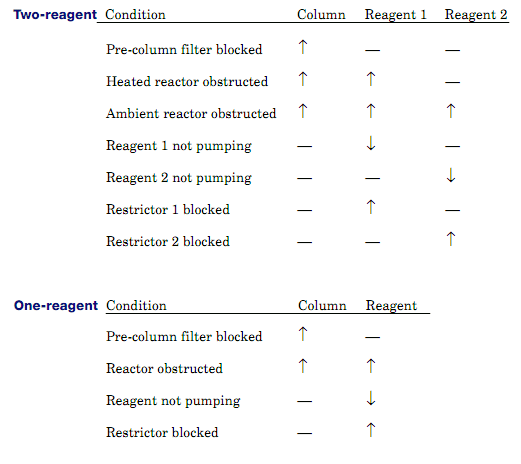
Here is an excellent resource for high pressure troubleshooting, for one-pump and two-pump post-column systems (Restrictor suggestions only applicable to Vector PCX and not Pinnacle PCX):

q20


Thank you!
Pickering Labs

Chromatography Quiz #20: Fun Facts, a Pickering Scavenger Hunt!

To celebrate our twentieth consecutive quiz, we have created a fun scavenger hunt of Michael Pickering factoids!  Answer the five questions correctly and win a prize!  Simply email your answer as well as your full contact information to Rebecca at rlsmith@pickeringlabs.com by September 15th, 2015 in order to win.  You will receive email confirmation that your submission has been received.  Answers to the questions and winner congratulations will be published in the next issue (to be anonymous, please notify Rebecca in submission). 

Hint: Michael Pickering writes the Random Tangents section of our blog!
  

Fun Facts about Michael Pickering, the Scavenger Hunt

Question One:  Through what organization did Michael first meet Laszlo Torma, our recently retired Director of Technical Relations?

 Question Two: To whom is the famous quote “Chance favors the prepared mind” attributed?

 Question Three: How long was Michael’s train ride from Anchorage to Fairbanks?

 Question Four: What phthalate caused Michael so much consternation both during school and later in a customer’s laboratory?

 Question Five: Michael suggests a recipe using saffron – what is he cooking? 


Bread Rises

SF-SourdoughRising to the Occasion
Michael Pickering

My wife Judy baked bread recently for our annual St. Patrick’s Day luncheon at Pickering Labs.  She’s an excellent baker, and her Irish Soda Bread is a favorite addition to the corned beef and cabbage “traditional” fare.  Soda bread uses baking soda instead of yeast as the rising agent for the dough.  In addition to baking soda, her recipe also calls for flour, salt, and buttermilk.  This is typical for soda bread, as the buttermilk contains the lactic acid required for the ‘rising’ reaction with the sodium bicarbonate. 

Having grown up in Southern California, I have fond childhood memories of another special kind of bread – Salt-Rising Bread.  This denser bread relies on the fermentation of salt-tolerant bacteria in cornmeal.  The cornmeal must be freshly stone ground, and the dry ingredients also include sugar and salt.  The starter is formed as scalded milk is poured over the dry ingredients, and then left to incubate for about twelve hours at 100 or so degrees.  Despite its name, salt is a relatively minor ingredient in the bread. 

The Van de Kamp’s bakery had a rich history which straddled my own childhood and years living in the greater Los Angeles area.  Although the bakery was originally sold by the Van de Kamp family back in the 1950’s when Theodore Van de Kamp died, the Dutch windmill style bakeries and fresh salt-rising bread remained a warm memory for many of us Southern California children.  When accompanying my mom to buy our bread, I was treated on more than one occasion to a free windmill toy and a cookie. 

By the mid-1970’s, the Van de Kamp bakeries had stopped baking the salt-rising bread I grew up on, but by that point I had left Southern California and moved up to the Bay Area, a region where the Van de Kamp bread had been seldom offered and shortly went out of business.  However, in San Francisco, sourdough bread reigned supreme and had since the California Gold Rush.

Sourdough bread also uses natural microbes as a rising agent, but the longer fermentation of the starter allows the Lactic Acid produced by the Lactobacillus to give the bread a uniquely sour taste.  Naturally occurring yeasts such as Saccharomyces exigua and Saccharomyces cerevisiae also participate in the rising.  Sourdough yeasts work slower than today’s packaged yeasts, increasing the time needed for fermentation to multiple days.  San Francisco sourdoughs are usually kept closer to 70 degrees and often need a week to become stabilized.

Flour and water are combined in the starter, and various methods for introducing micro-organisms and stabilizing the dough are used.  Often times, boiled potatoes are used to help increase the activity of the bacteria.  Creating a sourdough starter is a baker’s science, and each recipe is unique and starter closely monitored.  As a result, bakers are often using “mother dough” that is many years old.  Some bakeries, such as the Boudin Bakery, are able to trace their “mother dough” back to the Gold Rush era. 

During the 1980’s, as modern food processes and general business consolidation trended, San Francisco bakeries fell into the hardship of competition with prepackaged bread.  Smaller bakeries were driven out of business, and the long-term survivors tended to be the larger bakeries with well-established distribution channels.  I moved to Oregon during this time, and my observations upon returning to the Bay Area some years later made it clear that there was a stark change in the availability of good local sourdough bread.  Fortunately for my family, Judy was at the peak of her baking heyday during this time and we were seldom lacking in good bread around my house!

Fast forward to now, and the artisan bread movement has brought back the ability to purchase good, hand-made loaves of bread.  Specialty bakeries have been started and thrive in high numbers.  Even restaurants and grocery stores are taking the time to bake their own bread.  I personally continue to feel that no sourdough of modern San Francisco origin can compete to the distinct sour taste and texture of earlier days, but there is no Pickering starter dough dating back to 1970 lurking in my refrigerator, so I make do with what’s available.  It is my sincere hope that the continued evolution of artisan bread, gastronomy, and the souring culture will ultimately recreate my ideal sourdough again soon. 

Until then, at least we can look forward to St. Patrick’s Day each year, when Judy will rise to the occasion and bake a unique bread to treat us all again!


Replacing the Over-pressure Relief Valve Cartridge

Mixing-Manifold-1a 
Cleaning and Reassembly of the Over-pressure Relief Valve

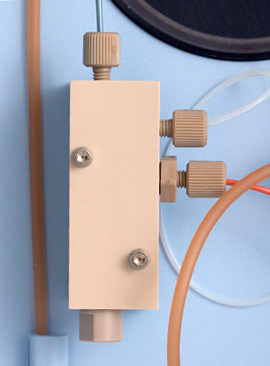
  1. Remove the tubing connections to the Mixing Manifold. Use a 3/32” hex driver to remove the 2 screws holding the Mixing Manifold to the chassis. Use a 3/8” wrench to remove the end cap and discard the old Over-pressure Relief Valve Cartridge. Ultrasonicate the Mixing Manifold for at least 30 minutes. Rinse well with DI water.


  2. Connect the outlet of your HPLC pump to the Mixing Manifold inlet and pump 100% water at 0.5mL/min to verify the Mixing Manifold is not clogged. If the Mixing Manifold is still clogged after cleaning in an ultrasonicating bath, replace the Mixing Manifold Assembly (PN 1452-0040).
     
  3. Turn off the HPLC flow and make sure there is no pressure on the Mixing Manifold. Insert the new OPRV cartridge, green side down, and screw on the end cap to 20”lbs of torque. To approximate this level of torque, first finger tighten, then tighten an additional 1/8-1/4 turn with a 3/8” wrench.
     
  4. To verify the opening pressure of the Over-pressure Relief Valve, plug the two side inlets of the Mixing Manifold and turn on the HPLC pump to 0.5mL/min. Allow the pressure to slowly rise. The Over-pressure Relief Valve should open around 485psi. If the opening pressure is too low, tighten an additional 1/8 of a turn with a 3/8” wrench.

David Mazawa
david.mazawa@pickeringlabs.com
Technical Support Chemist
Pickering Laboratories, Inc.
1280 Space Park Way
Mountain View, CA 94043 USA
Phone: (650)694-6700 ext. 710
Fax: (650)968-0749