Category Archives: pickering laboratories

Replacing the Over-pressure Relief Valve Cartridge

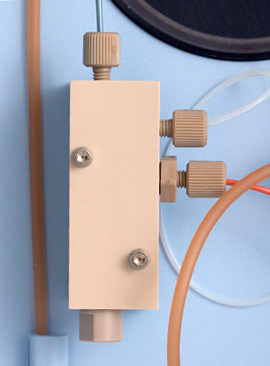
Mixing-Manifold-1a 
Cleaning and Reassembly of the Over-pressure Relief Valve

  1. Remove the tubing connections to the Mixing Manifold. Use a 3/32” hex driver to remove the 2 screws holding the Mixing Manifold to the chassis. Use a 3/8” wrench to remove the end cap and discard the old Over-pressure Relief Valve Cartridge. Ultrasonicate the Mixing Manifold for at least 30 minutes. Rinse well with DI water.


  2. Connect the outlet of your HPLC pump to the Mixing Manifold inlet and pump 100% water at 0.5mL/min to verify the Mixing Manifold is not clogged. If the Mixing Manifold is still clogged after cleaning in an ultrasonicating bath, replace the Mixing Manifold Assembly (PN 1452-0040).
     
  3. Turn off the HPLC flow and make sure there is no pressure on the Mixing Manifold. Insert the new OPRV cartridge, green side down, and screw on the end cap to 20”lbs of torque. To approximate this level of torque, first finger tighten, then tighten an additional 1/8-1/4 turn with a 3/8” wrench.
     
  4. To verify the opening pressure of the Over-pressure Relief Valve, plug the two side inlets of the Mixing Manifold and turn on the HPLC pump to 0.5mL/min. Allow the pressure to slowly rise. The Over-pressure Relief Valve should open around 485psi. If the opening pressure is too low, tighten an additional 1/8 of a turn with a 3/8” wrench.

David Mazawa
david.mazawa@pickeringlabs.com
Technical Support Chemist
Pickering Laboratories, Inc.
1280 Space Park Way
Mountain View, CA 94043 USA
Phone: (650)694-6700 ext. 710
Fax: (650)968-0749


Visit Pickering at Pittcon 2014

We will be displaying our equipment at this year’s Pittcon in Chicago, Illinois from March 3-6, 2014. Be sure to stop by:  Booth 2955

We will have our Pinnacle PCX post-column derivatization instrument on display as well as our Mycotoxin Analysis Products. In addition, we will some new videos to highlight the latest in our Automated Sample Preparation instrument the FREESTYLE SPE system.

Wendy, David and Mike will be in Chicago. Please stop by. We would love to talk with you!
fountain

Amino Acid Analysis of Monoclonal Antibodies

Method Abstract 373, Amino Acid Analysis of Monoclonal Antibodies

The peptide and protein based pharmaceuticals are a rapidly expanding class of therapeutical agents that are used to treat a wide variety of health conditions, including cancer, metabolic and auto-immune diseases, HIV and more. Biologic drugs, such as monoclonal antibodies, are derived from living organisms and are usually very expensive. As many biologics are coming off of patents, the market is ready for cost-saving biogenerics. But all proteins, including monoclonal antibodies, have complex structures that determine their function. Differences in structure would alter biological activity leading to changes in safety and efficacy of the drug.

ICH Q6B is a guidance document that provides a set of internationally accepted specifications for biotechnological and biological products to support new marketing applications. It establishes the set of criteria to which a drug substance, drug product or material should conform to be considered acceptable for intended use.

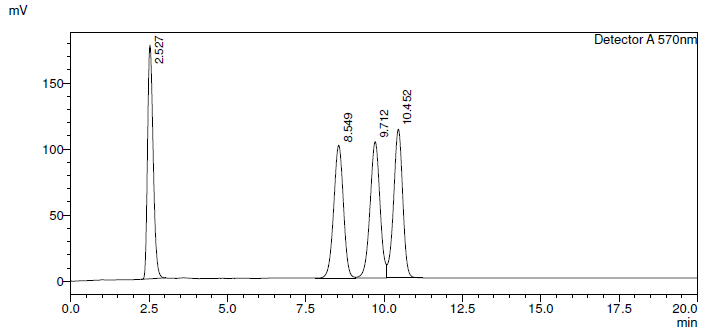
aaa chromatograms from MA373Determining Amino Acid composition following hydrolysis is listed in ICH Q6B as a way to characterize the protein and to confirm its identity by comparing with Amino Acid composition deduced from the gene sequence of the desired product. Amino Acid Analysis data is also used to accurately determine the protein content.

The Amino Acids Analysis with post-column derivatization is a very sensitive, reproducible and rugged method and it has been a preferred approach for laboratories running biological samples, protein, peptides and foods analysis. Pickering Laboratories Inc. offers many Amino Acids Analysis products including post-column derivatization instruments, columns, eluants, reagents and standards. All products are designed to work together to deliver optimum results for any chosen sample.

METHOD
Analytical conditions
Column: High-efficiency Sodium cation-exchange column, 4.6 x 110 mm, P/N 1154110T
Flow Rate: 0.6 mL/min
Mobile Phase: See method in Table 1

Post-Column Conditionsgradient table for AAA monoclonal AB
Post-column System: Pinnacle PCX
Reactor Volume: 0.5 mL
Reactor Temperature: 130 °C
Flow Rate: 0.3 mL/min
Detection: UV/VIS 570 nm for primary amino acids, 440 nm for secondary amino acids
Injection Volume: 10-50 uL

You can download this abstract, as well as our product catalog and other notes from our website: www.pickeringlabs.com


Calculation of Whey Protein Fraction in Milk-Based Infant Formula

A method for the calculation of whey protein fraction in milk-based formula products was developed and validated by a group of researchers from Abbott Nutrition, Covance Laboratories and AOAC International. The method is based on calculating the ratio of (Asx + Ala)/(Pro+Phe) determined from the amino acid profile of the hydrolyzed sample.

The method was approved as AOAC Official First Action Method 2012.07 and is appropriate for accessing compliance with whey content requirements of GB 10765-2010 (National Food Safety Standard Infant Formula)*. It is applicable to finished products containing both intact and partially hydrolyzed whey proteins.

According to this method, the Amino Acid Profile of hydrolyzed samples is determined using cation-exchange chromatography with post-column derivatization and UV/Vis detection. The researchers used Pickering Laboratories post-column derivatization system, our patented Trione Ninhydrin reagent and Pickering Sodium analytical column and buffers.

The method performance was evaluated using non-fat dry milk and products with whey levels from 32% to 63%, including NIST Infant Formula Standard Reference Material. The repeatability ranged between 0.3 and 2.5 %, while intermediate precision were between 2.6 and 3.4%. Average recoveries ranged from 97 to 100%.

The unmatched accuracy and precision of amino acid analysis by HPLC with post-column derivatization allowed the researches to develop a robust mathematical model for calculating whey protein fraction that can be successfully applied to a wide range of products. This proved once again that post-column derivatization analysis of amino acids is still a method of choice for laboratories that require highly accurate results.

Pickering Laboratories offers a total solution for amino acids analysis, including post-column derivatization systems, reagents, columns, buffers and standards.

The reference to the published study is below. The First Action Official Method 2012.07 can also be found online at http://www.eoma.aoac.org/.

Calculation of Whey Protein Fraction in Milk-Based Infant Formula: First Action 2012.07

Authors: Wesley Jacobs, Paul Johns, Phillip Haselberger, Joseph J. Thompson, Darryl Sullivan, Steve Baugh.

Source: Journal of AOAC International, Volume 96, No. 3, 2013, pp. 502-507


(*) this is a Chinese Standard

Amino Acid Analysis of Cell Culture Media

We have a new Method Abstract! MA371, Amino Acid Analysis of Cell Culture Media

Cell cultures are widely used to produce biopharmaceuticals and other biologically active compounds. The composition of the cell culture media affects the yield and structure of the desired products and must be carefully optimized. Cell culture media is typically composed of mixtures of amino acids, vitamins, carbohydrates, inorganic salts as well as different peptides, proteins and other compounds. As the cells grow, they consume nutrients and release target biopharmaceuticals as well as waste products.

Amino Acids serve as the building blocks of proteins, as well as intermediates in many metabolic pathways. Amino Acids are typically added to cell culture media to provide nutritional requirements for the cells. Monitoring and adjusting Amino Acid composition is an essential part of optimizing the manufacturing process to ensure high quality and optimum yield of the final product.

Amino Acid Analysis using cation-exchange chromatography with post-column Ninhydrin derivatization allows for easy determination of Amino Acid concentrations in many complex matrices, including cell culture media. The post-column method is very sensitive, reproducible and rugged. It has been and continues to be a method of choice for laboratories running biological samples, protein, peptides and foods analysis. Most chemical compounds present in the media do not interfere with analysis, so the majority of samples only need diluting with citric buffer and filtering before analysis. If serum is added to the media, then the proteins need to be precipitated using either Seraprep™ solution or ultrafiltration.

Pickering Laboratories, Inc. offers the complete solution for Amino Acid Analysis, including post-column derivatization instruments, columns, eluants, reagents and standards. The Pinnacle PCX derivatization system has a programmable column oven to allow for shorter run times and easy method optimization.

YChromatograms of Cell Culture Mediaou can download this application note, and many others from our website: www.pickeringlabs.com

METHOD
Analytical conditions
Column: High-efficiency Lithium cation-exchange column, 4.6 x 75 mm, Catalog Number 0354675T
Flow Rate: 0.55 mL/min
Mobile Phase: See method in Table 1

Post-Column Conditions
Post-column System: Pinnacle PCX
Reactor Volume: 0.5 mL
Reactor Temperature: 130 °C
Flow Rate: 0.3 mL/min
Detection: UV/VIS 570 nm for primary amino acids, 440 nm for secondary amino acids
Injection Volume: 10-50 uL

gradient table for AAA

Polyether Antibiotics in Animal Feed

Our updated Method Abstract 264 describes the analysis of Monensin, Salinomycin, Narasin, & Lasalocid in Animal Feeds.

Polyether Antibiotics are commonly used for preventing coccidiosis and other infections in poultry and for improving feed efficiency for beef cattle and swine. The use of Polyether Antibiotics is strictly regulated, with only specific ionophores approved for use in feeds intended for different animals.

Analysis of Polyether Antibiotics by HPLC with post-column derivatization and UV/Vis detection has been proven to successfully identify and quantify Monensin, Narasin and Salinomycin in medicated feeds, supplements and premixes as well as to determine trace contamination levels in non-medicated feeds [1, 2].

Post-column derivatization of Polyether Antibiotics is done using highly acidic Vanillin or DMAB reagents. The Pinnacle PCX derivatization system (Pickering Laboratories, Inc.) has an inert flow path and automated system wash capabilities that make it uniquely suitable for handling corrosive reagents. The two-pump system is recommended to extend reagent stability, but the single-pump system for this application is also available.

Adding a Fluorescence detector to the instrumentation allows for using the same extraction procedure and HPLC conditions to also determine Lasalocid, which doesn’t require post-column derivatization.

Chromatograms of Polyether AntibioticsMETHOD
Sample Preparation
To 25 g of finely ground feed sample, add 100 mL of extraction solution (90% Methanol – 10% water). Shake for 1 hour at high speed using a mechanical shaker. Let the solids settle and filter an aliquot of the extract for injection. Dilute with extraction solution if needed to fit the calibration curve. Use a 2.5 g portion when testing premixes.

Analytical conditions
Analytical Column: Polyether Column, C18, 4.6 x 250 mm, Catalog No 2381750
Temperature: 40 ºC
Flow Rate: 0.7 mL/min
Mobile Phase: 90% Methanol, 10% of 5% Acetic Acid solution in water, isocratic
Injection volume: 20 μL

Post-Column Conditions
Post-column System: Pinnacle PCX
Reactor Volume: 1.4 mL
Reactor Temperature: 90 °C
Reagent 1: Concentrated Sulfuric acid / Methanol (4:96 v/v)
Reagent 2: 60 g of Vanillin in 950 mL of Methanol
Reagent Flow Rate: 0.3 mL/min
Detection: UV/VIS 570 nm (for Lasalocid – FLD, Ex. 322 nm, Em. 370 nm)

Conclusion
Analysis of Polyether Antibiotics by HPLC with Post-column derivatization is a robust and sensitive method that utilizes standard equipment and could easily be adopted by testing laboratories. It allows for testing of different ionophores at wide range of concentrations,
including at trace levels. Using Pinnacle PCX post-column derivatization system, factory configured for the analysis, guarantees stable and reproducible results.

The full application note as well as our complete Product Catalog can be downloaded from our website: www.pickeringlabs.com

table for polyether antibiotics

2013 Pickering Laboratories North American Catalog

Our latest Catalog for North America is now available!

Click on the link to download the latest product Catalog from Pickering Laboratories, Inc.

Pickering Catalog: http://pickeringlabs-retentiontimes.com/wp-content/uploads/2013/08/2013_PickeringLabs_Catalog_NorthAmerica_LowRes.pdf

Inside our catalog you will find a complete product listing for all instruments and consumables we currently have available. From Sample Cleanup to Post-Column Derivatization, to artificial Perspiration and Saliva, we hope you find something you will find useful!