
Pickering Laboratories
Menu
 
Menu

New Application Notes

ANALYSIS ANALYSIS OF MYCOTOXINS IN CANNABIS PLANTS AND CANNABIS-CONTAINING PRODUCTS OF MYCOTOXINS IN CANNABIS PLANTS AND CANNABIS-CONTAINING PRODUCTS

State regulations have established maximum allowed levels for Mycotoxins in Cannabis-containing products sold to consumers at the following maximum levels: levels for total Aflatoxins G1, G2, B1 and B2 are set at < 20 ppb and levels for Ochratoxin A at < 20 ppb. Pickering Laboratories developed an easy and sensitive method to analyze Aflatoxins B1, B2, G1, G2 and Ochratoxin A in cannabis plants and edible products. Mycotoxins are isolated using immunoaffinity clean-up columns and analyzed with fluorescence detection. To increase sensitivity of Aflatoxins B1 and G1, an in-line photochemical reactor is installed before the detector. This method utilizes standard HPLC equipment and allows testing laboratories to easily determine Mycotoxins at levels below the limits established by state regulations.

Click to download  Analysis of Mycotoxins in Cannabis Plants and Cannabis Containing Products (MA241).

ANALYSIS OF AMINO ACIDS IN DIETARY INGREDIENTS AND SUPPLEMENTS

Analysis of amino acids using cation-exchange columns and Ninhydrin post-column reagent is well-establish methodology that is recommended by the European Pharmacopeia. Pickering Laboratories developed and validated a post-column method for amino acids analysis of dietary supplements that is sensitive, selective and can be used without modifications to analyze capsules, tablets, drinks and other samples. Accelerated methods are available for samples with a limited number of amino acids. 

Click to download  Analysis of Amino Acids in Dietary Ingredients and Supplements (MA397)

Glyphosate in the News

 
As you may have noticed, Pickering Laboratories has been periodically updating our newsletter subscribers on Glyphosate-related reports in the news.   We are interested in the evolving current events related to Glyphosate regulation and the new research being conducted worldwide. 


Here’s the latest:

Glyphosate residue-free inquires surge as ‘Clean Food’ movement gathers pace.
Glyphosate is being food in consumer products and consumers are finding that a choice is possible.

Common weed killer linked to bee deaths.
A study has found that Glyphosate is a factor in bee deaths and determined the mechanism of effect.

Previous Articles on Glyphosate
Pickering Laboratories offers a post-column method for Glyphosate analysis that has been the industry standard for many years. Our methodology is simpler and more sensitive than LCMS, not to mention less expensive. Please contact us to speak with a chemist about post-column instrumentation or for tips and tricks to improved sample preparation, lower detection limits, or if you’ve got a new sample matrix in mind.

Reagent and Gas Line Clips

Dear valued customer,

You may have noticed that the stiff tubing of the reagent line will sometimes unscrew itself from the white adapter and cap. This will usually end up in a big mess. We have found that securing the gas line and reagent lines together will secure the reagent line and prevent it from unscrewing on its own. We will be launching the Reagent and Gas Line Clips on Oct 8, 2018. Any Vector or Pinnacle manufactured on or after this date will include the new clips. The gas and reagent line clips will also be included with all reagent caps. You can also order packs of two with the ordering information below:
   

1452-0356       Reagent & Gas Line Clips, pack of 2
  

Please contact Pickering Support with any questions.

David Mazawa
david.mazawa@pickeringlabs.com
Technical Support Chemist

Sodium Amino Acid Standard with Norleucine

Dear valued customer,

A new amino acid standard is available for your convenience. This expanded comprehensive set of amino acids with internal standard, Norleucine, can be used for oxidized or non-oxidized samples.

Please see the components listed below.

1700-0165  Sodium Amino Acid Standard with Norleucine, 0.25µmole/mL, pack (5x1mL)

Compound
   
L-Alanine 
Ammonia    
L-Arginine
L-Aspartic acid 
Cysteic acid
L-Glutamic acid  
Glycine
L-Histidine  
L-Isoleucine 
L-Leucine  
L-Lysine
L-Methionine-D,L-sulfone 
L-Phenylalanine
L-Proline
L-Serine
L-Threonine  
L-Valine               
Taurine   
L-Cystine    
L-Methionine  
L-Tyrosine 
Tryptophan
Norleucine
Concentrations µM/mL
 
0.25
0.25
0.25
0.25
0.25
0.25
0.25
0.25
0.25
0.25
0.25
0.25
0.25
0.25
0.25
0.25
0.25
0.25
0.25
0.25
0.25
0.25
0.25


Please contact Pickering Support with any questions.

David Mazawa
david.mazawa@pickeringlabs.com
Technical Support Chemist

Chromatography Quiz #30

Chromatography Quiz #29: Amino Acids Elevated Baseline – RESULTS

Pickering Labs would like to congratulate all of our winners for our previous newsletter’s Elevated Baseline Amino Acids Chromatogram: Tom Schneider from Suffolk County Water Authority, Narjes Ghafoori from LA County Environmental Toxicology Lab, and Dr. David Green from Pepperdine University!

Winners will soon receive: A Harvest Bundle of Gifts from www.HarryandDavid.com!

This bountiful harvest bundle includes: creamy Pumpkin Cheesecake, a beautiful Autumn Garden Party plant gift, and a Pumpkin-Shaped Gift Basket which features juicy pears, pumpkin bars, cranberry relish, and much more. It’s the perfect way to celebrate the changing of the seasons. Best of all, bundle gift items are sent individually to make the celebration last a little longer!

Congratulations to our quiz winners and we hope they look forward to receiving their gifts next week!

Thank you all for your submissions!


The correct answers for the Elevated Baseline Amino Acids Chromatogram are as follows:

The shift on the baseline is called an ammonia plateau and it is due to the presence of low-level amines and ammonia in the buffers. These compounds accumulate on the column during equilibration time and come out during the gradient in a form of a plateau. Since the buffers have low pH, these compounds are unavoidable but care should be taken to avoid excessive contamination that can cause the plateau to be too high. Amines are present even in the air and get dissolved in buffers as time goes by.

The issue usually comes from buffer A. Try and replace with a new lot if possible.

Below are some tips on how to minimize any potential problems:

  • Remove all filters from the ends of HPLC lines that go into the buffer bottles. All our products are filtered before bottling and these in-line filters only drag contamination from one bottle to another.
  • Replace open buffers on the instrument at least every two weeks. If you don’t use the full bottle in 2 weeks, pour half of the bottle into a clean glass bottle to put on the instrument and tightly cap the remaining portion to keep until future use.
  • Don’t flush column with water, use only Column Regenerant for cleaning the column.
  • Don’t use the first injection of the sequence for calculations since it usually has a different profile due to differences in equilibration time.
  • Program the needle wash between the runs to avoid carry over.
  • If you see unexpected peaks on your blank or other chromatograms make a fresh vial of the solution and run again to confirm the problem. Also run “No Injection” to see if the peaks are coming from the injected sample of from the baseline.
  • Flush HPLC periodically with 100% water, then 100 % methanol, then 100 % water with no column attached (!!!) to keep the lines clean.

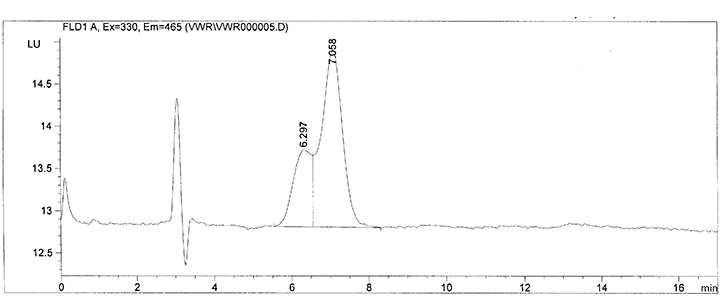
Chromatography Quiz #30 – Aflatoxins Analysis, Decreased Signal:

Simply email your answer as well as your full contact information to Rebecca at rlsmith@pickeringlabs.com by December 21, 2018 in order to win. You will receive email confirmation that your submission has been received. The answer to the quiz and winner congratulations will be published in the next issue (to be anonymous, please notify Rebecca in submission).

Aflatoxin analysis by photochemical derivatization is achieved with the parameters listed below:

Analytical Column: Mycotox Column, C18 4.6x250mm
HPLC Eluent: Sodium Phosphate buffer PN 1700-1108/Methanol/Acetonitrile (57/28/15)
Flow Rate: 1 ml/min
FLD: Excitation 365nm, Emission 430nm
UVE Photochemical reactor with 254nm UV light: 1.0ml knitted reaction coil.


What could contribute to a decrease in signal?


Biopharmaceuticals and Amino Acids Analysis

By Maria Ofitserova

Biopharmaceuticals are large molecules produced by or extracted from biological sources. They are used for therapeutic as well as diagnostic purposes and include recombinant proteins, antibodies, vaccines, blood factors, hormones and many other types of substances. Currently, there are more than 200 biologics on the market and they account for almost a third of all pharmaceuticals under development.

These unique substances revolutionized the pharmaceutical industry and brought tremendous improvement to the treatment of many medical conditions. They also brought their own set of challenges in manufacturing, quality control and regulations. Most biopharmaceuticals are developed by using recombinant DNA technology, where specific proteins are produced by genetically engineered cells.  As such, biologics are very sensitive to changes in the production process and they are more difficult to characterize than synthetic drugs. Even small changes in manufacturing conditions or cell lines can cause considerable variations in final product, causing differences in therapeutic action. That is why, unlike with synthetic generic drugs, biosimilar compounds require clinical trials to prove the drug equivalency.

All cell lines require media to grow and function. Cell culture media have complex composition that needs to be optimized to ensure proper functioning of the cell lines. The type of media needed would depend on the manufacturing process mode as well as stage of cell line life. For example, media needed for optimum cell growth would be different from the one required for optimized production rate of the final product. Optimum cell media should be able to sustain high cell density and maximized production yield.

Amino acids, being the building blocks of proteins, are necessary ingredients of all cell culture media. Since cells can’t synthesize essential amino acids, they must be included in the media to ensure cell propagation and functioning.  L-Glutamine is one of the most important essential amino acids since it serves as a Nitrogen source as well as energy source for cell metabolism. Non-essential amino acids also get depleted during cell line lifetime, so supplementation of such amino acids as L-Proline, L-Serine and L-Alanine is also necessary. Monitoring amino acids at various stages of the manufacturing process ensures viability of the cells and high quality of the final product.

Due to complexity of composition and structure, biopharmaceuticals are challenging to characterize. A wide array of methods, such as immune assays, gel electrophoresis, different chromatographic and mass spectrometric techniques are used in combination to fully confirm the substance purity and identity. The ICH Q6B is a guidance document that provides a set of internationally accepted specifications for biotechnological and biological products to support new marketing applications. (https://www.fda.gov/downloads/drugs/guidancecomplianceregulatoryinformation/guidances/ucm073488.pdf) Determining amino acid composition following hydrolysis is listed in Q6B as a way to characterize the protein and to confirm its identity by comparing with the amino acid composition deduced from the gene sequence of the desired product. Amino acids analysis data is also used to accurately determine the protein content.

Pickering Laboratories offers methods to analyze amino acids in hydrolyzed protein samples and well as cell culture media. See our application notes 373 and 371 for more information.

https://www.pickeringlabs.com/wp-content/uploads/2015/03/MA371_010415_Web.pdf

https://www.pickeringlabs.com/wp-content/uploads/2015/03/MA373_010415_Web.pdf


Free-Range Parenting, Pasture-Raised Eggs and No Antibiotics Ever Chickens

By Rebecca Smith

As most of you know, Pickering Labs is a small company.  We all work on a single shift, so pretty much everyone is in the lunch room at the same time each day.  That makes for a wide range of conversational topics daily, which are often influenced by the San Jose Mercury newspaper on the table or the contents of the local news the evening before. 

When Utah passed their “Free-Range Parenting” law, it made national news back in March.  It also made conversation in the Pickering breakroom!  We discussed the definition provided for free-range parenting and concluded that here at Pickering we needed more options for defining parenting styles.  Enter the new supplemental phrases: cage-free parenting and pasture-raised parenting!  Taken from the Humane Farm Animal Care Standards, we decided that a cage-free child was the most closely supervised, followed by a free-range child (allowed some autonomy) and finally a pasture-raised child, which was given the most license to roam.  It’s interesting that although most of us considered ourselves to have been pasture-raised in our childhoods, many of the staff employed a more cage-free or free-range style when raising their own children. 

As Saji, Anita and Gabriela discussed the pros and cons of degrees of parental supervision (while giving David plenty of advice for raising his 15-month old daughter), I wondered what impact the ‘parenting’ differences had on the hens and their eggs…  It was lunchtime after all! 

It appears that pasture-raised eggs might have health benefits over commercially-raised eggs, including increased omega-3 fatty acids, vitamin E, vitamin A, and beta carotene.  They also have reduced cholesterol and saturated fats, both of which the American Heart Association recommends reducing in your diet to lower your risk of heart disease and stroke.  The differences in the eggs come from the chickens’ diet: pasture-raised hens eat grass and bugs in addition to the grain feed given to commercially-raised hens.

So, while we’re talking about the chickens’ diet and lifestyle, what else can contribute to the health and wellbeing of these hens?  After additional research, I discovered that poultry farming comes with its own bill of rights!  Called the Five Freedoms for Poultry, chickens are raised humanely when their basic needs are met (food, water, safety) but they are also given the freedom to express their natural behaviors and they have rapid access to diagnosis and treatment of injury or disease. 

Now I’m onto something!  But does a happier chicken make a tastier egg, or just a healthier one?  It’s hard to find scientific studies on taste, although you can find loads of data on the differences in composition of meats raised in different ways.  Composition impacts how healthy the egg is, but when it comes to its actual taste, apparently the mindset of the person tasting and the color of the egg might have more bearing on perceived taste than anything else, including whether the hen was pasture-raised or conventionally-raised. 

Even if taste isn’t a factor, purchasing healthier eggs and meat coming from happier hens can still be a worthwhile grocery shopping practice!  Top concerns include the environmental and human health effects of antibiotics use in the production of food, a topic that has gained steam in consumer awareness in more recent years and has been studied for several decades internationally.  As the public increases its attention on antibiotics use and antimicrobial resistance, farmers are beginning to make changes to the manner in which antibiotics are used in livestock farming.  And for good reason, as their livelihood could face increased pressure from the eventual market introduction of synthetic or lab-grown meats

In response to consumer concerns regarding food production, moving away from antibiotics use became a top priority for Perdue Foods, one of the biggest poultry producers in the United States.  Perdue began the process of raising poultry without antibiotics fifteen years ago, and they have hit a major milestone with 100% of the birds they produced in 2017 raised “No Antibiotics Ever,” meaning that from hatchery through slaughter, the birds are never treated with any antibiotics during their lifetime.  If the use of antibiotics become medically necessary for a bird, the animal is treated as needed but removed from Perdue Foods branded production.  All human and animal antibiotics have been removed from the feed and hatchery, and animals are raised in a way that does not require antibiotics for disease prevention. 

In fact, remember the Five Freedoms of Poultry?  Perdue continues to improve their implementation of the Animal Care Initiative, adding windows and enrichments to encourage bird activity.  Says Mike Leventini, manager of live production activities at Perdue Foods: “We believe an active chicken is a healthy chicken, it simply goes hand in hand.”  An impressive philosophy to implement for a company that processes 13 million birds per week from over 2,100 farms around the United States! 

Did you know Pickering Labs services the animal feed industry?!  We offer post-column methodology, instruments and consumables for the analysis of polyether antibiotics in animal feeds as well as the analysis of aminoglycoside antibiotics in feeds and the analysis of sugars in feeds.  We are also continuously improving our amino acids analysis in feeds and offer a wide range of post-column methods for oxidized and unoxidized feed samples

Most recently, our R&D team released a fast and sensitive method for the analysis of fumonisins in grains and feeds, which is particularly of interest due to the health problems caused in horses and swine.  You might remember our contaminated feed concerns from a previous newsletter article which discussed the risks of mycotoxins to livestock. 


Guaranteed Chemistry