Pickering Laboratories
Menu
 
Menu

Antioxidants Are No Accident

Recently we learned about a paper published by a team in Poland describing their work on the analysis of anti-oxidants. We wanted to share this work with the AHPA community.
Barbara Kusznierewicz and her colleagues from Gdansk University of Technology have developed a method to analyze antioxidants in complex mixtures by HPLC with post-column derivatization and UV/Vis detection. The authors studied three well-known reagents routinely used in colorimetric assays to measure antioxidant activity. They determined that Diammonium 2,2′-azinobis(3-ethylbenzothiazoline-6-sulphonic acid) (ABTS) and Folin-Ciocalteu reagent (FCR) were best suited for post-column derivatization of antioxidants after they were separated on reversed-phase HPLC column.
Photo from FoodProductDesign.com

Researches optimized HPLC conditions as well as post-column parameters such as concentration of post-column reagent, duration of derivatization reaction and reaction temperature. Trolox and 20 other phenolic compounds were investigated and scientists were able to demonstrate good correlation between Trolox equivalent antioxidant capacity (TEAC) determined by HPLC with post-column derivatization and standard colorimetic assay. This method was successfully applied to analysis of extracts from sloe fruits and mirabelle plums and allowed to calculate concentration of individual antioxidants as well as TE antioxidant capacity.


Pickering Laboratories strives to provide new post-column applications, and the instruments and chemistry to support these applications. It is our philosophy to provide a complete solution and customer support. We plan to follow-up this interesting research with some development of our own to see if we can optimize the post-column technique further. 
The full version of the paper can be found in the Wiley online library:
REFERENCE:
Kusznierewicz, B., Piasek, A., Bartoszek, A., Namiesnik, J., “The Optimisation of Analytical Parameters for Routine Profiling of Antioxidants in Complex Mixtures by HPLC Coupled Post-column Derivatization,” Phytochemical Analysis, 22, 392-402 (2011)

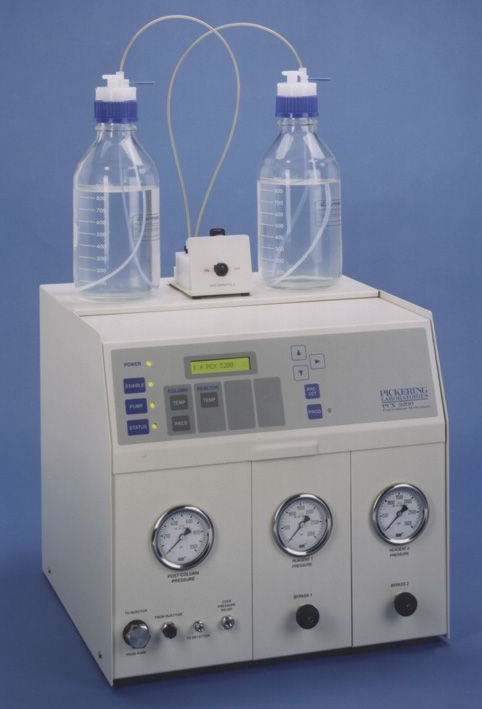
New! FREESTYLE Series Instrumentation

Pickering Laboratories introduced the Freestyle™ Sample Clean-up workstation from LCTech at this year’s AOAC International meeting in New Orleans.  Building on the success of the GPC Ultra product line of Gel Permeation Chromatography systems,  the FREESTYLE™Series  is an innovative design adding new time saving features to the automated sample clean-up work flow.

The Freestyle™ begins with:

  • FREESTYLE Basic, which has an XYZ robotic arm for automated liquid handling; dilutions, additions, mixing, extraction, dispensing, and other operations.
  • Add the GPC module for GPC processing of up to 4 GPC columns. 
  • Add to this the SPE module to enable SPE processing. 
  • Add the EVA module for programmable evaporation and solvent exchange for a completely automated in-line evaporation instrument.
Flexibility of the system starts with the suspended rack design. The system can handle multiple vial shapes from 1mL to 1000mL.

The FREESTYLE™software is drag and drop to program multiple sample parameters and able to handle exceptions to insert into the workflow. Graphical reporting and full audit logs round out the robust software.

The FREESTYLE™ automation of sample clean-up saves time, improves consistency and protects your staff from potentially harmful chemical exposure.

Send us an email or give us a call to find out how FREESTYLE™ can solve your sample clean-up challenges. 

Email: sales@pickeringlabs.com
Phone: Toll-free: 800-654-3330, Direct: 650-694-6700

Pickering Participates in BCEIA 2011 in Beijing, China

By David Mazawa
Beijing, outside of Exhibition Center
The Beijing Conference and Exhibition on Instrumental Analysis was held on October 12-15, 2011 at the Beijing Exhibition Center. This biennial exhibition is sponsored by the China Association for Instrumental Analysis and supported by the Ministry of Science and Technology of China. The BCEIA is 3 days long, because it will take you a full three days to cover all 17,000m² of exhibition space. 

The Beijing Exhibition Center became a bustling city of exhibitors and guests from all over the world showcasing instruments from the fields of Electron Microscopy & Material Sciences, Mass Spectrometry, Optical Spectroscopy, Chromatography, Magnetic Resonance, Electroanalytical Chemistry, Analytical Techniques in Life Science and Environmental Analysis.

BCEIA Exhibition Hall

David and Ameritech in Tianjin City
David and Tegent
I traveled to China to support our distributors that represented Pickering Laboratories at the BCEIA. I gave training to Ameritech in their Tianjin office and to Tegent in their Shanghai office. 
Both distributors have been working with Pickering Laboratories for many years and are completely capable of supporting our post-column instruments and applications. Their hospitality was incredible and I look forward to visiting them again in the near future.

 
Feel free to contact either Ameritech or Tegent for sale inquiries in China.


The Great Wall of China


David Mazawa

Technical Support Chemist
Pickering Laboratories, Inc.
1280 Space Park Way
Mountain View, CA 94043 USA
Phone: 650-694-6700 ext 710
Fax: 650-968-0749

Chromatography Quiz

Chromatography Quiz #7 Results
 

We would like to congratulate the grand prize winner of our last newsletter’s Amino Acid Analysis Chromatography Quiz: Jaime Lee Palmer from Underwriters Laboratories!!!

She has won, and will shortly be receiving: a gift card for Barnes and Noble!  Additionally, for this quiz all our participants will each be receiving a Smiley Face Sampler Box courtesy of The Popcorn Factory!  Again, we would like to thank all of you for your submissions. 
 
The correct answer for the modified Amino Acids chromatogram: the Trione reagent is oxidized.  Either the reagent has been improperly stored (not under Nitrogen), or has been in extended contact with air. 

Thank you! 
Pickering Labs

Chromatography Quiz #8:

Identify the error made when running the Carbamates chromatogram below and win a prize!  Simply email your answer as well as your full contact information to Rebecca at rlsmith@pickeringlabs.com by January 31st in order to win.  You will receive email confirmation that your submission has been received.  The troubleshooting answer and winner congratulations will be published in the next issue (to be anonymous, please notify Rebecca in submission). 

Carbamate Analysis for US EPA Method 531.1

Pickering Column: 1846250 Carbamate Column, C18, 4.6 x 250 mm

Sample: Actual customer’s 531.1 standard at 10ppb

Normal Operating Conditions: (for reference only, condition changes may be reflected in chromatogram)

Column Temperature: 42 °C

Flow rate: 1 mL/min

Eluant Gradient:
     

TIME
WATER
MeOH %
0
85
15
1
85
15
44
25
75
44.1
0
100
49
0
100
49.1
85
15
57
85
15

Post-column conditions:
Reagent 1: Hydrolysis reagent CB130 

Reagent 2: 100 mg of OPA, 2 g Thiofluor™ in 950 mL of CB910

Reactor 1: 100 °C, 0.5 mL 
Reactor 2: ambient. 0.1 mL
 

Reagent flow rates: 0.3 mL/min

Detection: Fluorometer  ex 330 nm,  em 465 nm

Full Chromatogram:


 Enlarged View:


Further Enlarged View:
  

For an example of a Good Carbamate Chromatogram, click here

SupplySide West Expo 2011

By Mike Gottschalk

Laszlo Torma inside the Venetian Hotel & Casino

The Supplyside West Conference is a very important Herbal Supplement Industry event. It provides important educational and networking opportunities to this $29 billion market. Since the FDA set out required current good manufacturing practices (cGMP) in 2007, the Herbal Supplement producers are working to meet the new requirements before the FDA audits. These regulations are intended to insure the quality, purity and safety of the Herbal Supplement products available today.  


The show is held in Las Vegas, Nevada, October 19-23. Pickering Laboratories exhibited at the show. We introduced our instruments, and methods to the industry. Of primary concern are Mycotoxins and Amino Acids, but also pesticides. Our GPC Clean-up and post-column instruments are well-suited to these applications. 

In addition to the literature and instruments in the booth, we presented two posters:

“Immunoaffinity Clean-up and  Analysis of Aflatoxins and Ochratoxin A in Herbs & Spices using HPLC with Post-column Photochemical Derivatization”

The production of herbal supplements and spices is a fast growing industry. There are numerous reports on the presence of Mycotoxins in commercially available herbs and spices such as chamomile, black and white tea leaves, ginkgo leaves, paprika and cumin. We developed a simple, sensitive and robust HPLC-Post Column Derivatization method for analyzing Aflatoxins B1, B2, G1, G2 and Ochratoxin A in herbs and spices. AflaOTAClean Immunoaffinity columns contain antibodies specific for both classes of Mycotoxins and allow for fast and efficient sample clean-up. We used the AcceClean automated workstation, which processes three samples simultaneously.


“Accelerated Amino Acids using HPLC with Post-Column Derivatization”

We developed an accelerated amino acids analysis method for Physiological and Protein Hydrolysate samples that utilizes temperature and eluant gradients. Protein Hydrolysates can be analyzed in 48min (inject-to-inject). Amino Acid Analysis is an important step in the Quality Control and R&D of dietary supplements, sports drinks, pharmaceuticals and in any type of sample where the amino acid content is of importance. The objective of the study was to reduce the total run time of Amino Acid Analysis by implementing both a column temperature gradient and a linear buffer gradient using HPLC with Post-column derivatization.
If you would like a copy of either or both of these posters or any additional information  about our products, please feel free to send us an email or give us a call:

Phone: Toll-free: 800-654-3330 Direct: 650-694-6700

Dinner on the canal in “Venice”

AOAC International 2011

By Mike Gottschalk
Any trip to New Orleans requires a visit to
Cafe du Monde for coffee and beignets

The annual meeting of the AOAC International in New Orleans, Louisiana on September  18-21, had a strong emphasis on Herbal Supplements testing. The AOAC organization is central to FDA efforts to provide analytical structure to testing methods for this newly regulated industry. 

Pickering Laboratories participated in the AOAC sponsored Single Laboratory Validation of Multi-residue Mycotoxin Analysis in Feeds and Grains. For this work, Pickering Laboratories was awarded the “Single Lab Validation of the Year”. This pivotal work in the analysis of Mycotoxins continues in Herbal Supplements as well as agricultural products. 

We presented our new instrumentation and a poster titled “Analysis of Paralytic Shellfish Toxins in Bivalve Mollusks using HPLC with Post-column Derivatization and Fluorescence Detection”

In support of our new instrumentation, the incredibly versatile FREESTYLE series, we presented the highlights and capabilities in our Vendor session on Tuesday afternoon. You can find more details about Freestyle in a separate blog post and on the LCTech website: http://www.lctech.de/english/FREESTYLE-GPC.html

The post-column method for Paralytic Shellfish Toxins presented in our poster is now a official AOAC Method:  OMA 2011.02. Earlier in 2011, we attended the 2nd Joint Symposium & AOAC Task Force Meeting on Marine & Freshwater Toxins meeting in Spain in support of the work done by Mr. Jeffery van der Riet to complete method 2011.02.  You can read about the meeting and the method in an earlier blog post.
If you would like a copy of the poster or any additional information  about our products, please feel free to send us an email or give us a call:

Phone: Toll-free: 800-654-3330 Direct: 650-694-6700


Good Toys Stimulate Imagination

By Michael Pickering

A sandbox is a reasonably scaled and so infinitely variable a toy that it should be an important consideration for any family with children and the use of about 20 square feet of ground.  The basic design is simple: 1) Make a collar of the depth you want out of rot-resistant material (i.e. heart redwood, cedar, et. al.) and 2) fill to desired level with sand.

That is the most obvious design consideration but not the most important factor by far.  Sand management is the important issue.  Sand is predominantly silica (aka quartz) and as purchased is fine grained and fairly uniform in size.  Thus it packs densely.  The most critical property is the extremely hydrophilic nature of silica.  It can sustain a great deal of water just by surface tension.  So, if you put sand in a blind hole on dirt, once it gets wet it can readily puddle and take weeks or months to dry, depending on where you live.  It rains sometime where most people live.  And to maximize the “toy-ness,” the sandbox must quickly drain so the children can add a dribbling hose to the party.

A design that worked for our four children:
Our sandbox is 6’ x 6’ x 1’ and is filled to 8” deep.  About 25 cubic feet of sand in all.  Although it is simple arithmetic, I’m going to give you the small numbers to inspire you.  Its position on the ground is controlled by gravity.  The mount is three layers:

  1. Gravel, also called drain rock, minimum one inch deep – 3 cubic feet
  2. Galvanized fencing, ¼ inch mesh, 36 square feet
  3. Aluminum screen, 36 square feet
  4. When not in use, protect your sandbox with a screen to keep the local cats out

Play Time:
You can also add a degree of nonsense.  I added marbles, surf tumbled beach glass and stainless flatware from the local Goodwill.  Our children would squirt water droplets into the air and the humming birds would come to collect them.  It was a four-act play that had a long run.

Guaranteed Chemistry